
Spa-Francorchamps Circuit Guide: Every Corner of F1’s Longest Lap

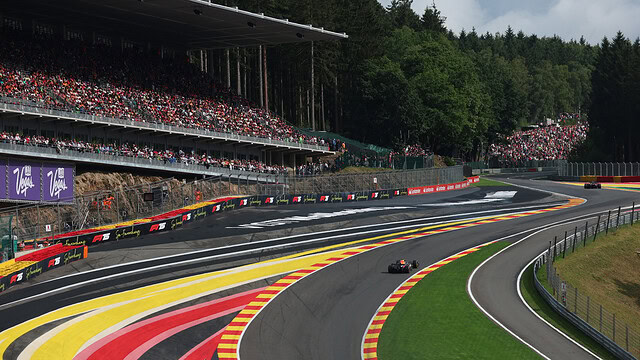
- Spa-Francorchamps stretches 7.004 km through the Ardennes forest with 102 metres of elevation change and 19 corners, making it the longest and most vertically dramatic circuit on the F1 calendar.
- The pit lane at Spa produces the cheapest pit stop in Formula 1: a median total cost of 18.4 seconds across the 2022-2024 era data, more than nine seconds cheaper than Imola’s 28.1-second average at the top of the range.
- Five Straight Mode zones give Spa more active aero activation than any other circuit in 2026, while the season’s inverted tyre hierarchy faces its toughest examination yet through Pouhon’s sustained lateral loads.
Spa-Francorchamps Circuit Guide
Spa-Francorchamps covers more ground than any other circuit Formula 1 visits. At 7.004 km, its lap is nearly twice the length of the Red Bull Ring’s and roughly a kilometre longer than Silverstone’s, winding through a forested valley in the Belgian Ardennes that rises and falls by 102 metres between its lowest point at Stavelot and its highest at Les Combes. The Belgian Grand Prix has occupied this stretch of public road since 1925, and the circuit’s defining characteristic has never changed: it demands low-downforce configurations on a layout that simultaneously punishes any lack of aerodynamic grip. Oscar Piastri, who won the 2025 race after overtaking Lando Norris through Eau Rouge on the opening lap, put it simply when asked what makes the track stand out: “There’s never really going to be a track like Spa again, through the middle of a forest. We’re not going to have racetracks like that again. So I think that’s why it’s so special.”
La Source and the Pit Lane That Costs Almost Nothing
A lap of Spa-Francorchamps begins with one of its slowest corners. La Source is a tight hairpin at the end of the start-finish straight, taken in first gear at approximately 85 km/h after braking from around 300 km/h. Brembo data shows drivers apply roughly 111 kg of force to the brake pedal for 3.3 seconds across 145 metres of deceleration, pulling 3.6g. The hairpin feeds directly onto the downhill plunge toward Eau Rouge, so exit speed from La Source dictates how much momentum a driver carries into the most famous sequence of corners in motorsport.
La Source also sits directly adjacent to the pit lane entry, and this counts for more than the corner itself from a strategic standpoint. Spa hosts the cheapest pit stop in Formula 1: 18.4 seconds median total cost across the 2022-2024 era data, the lowest of any circuit measured. For context, the most expensive stop on the calendar is Imola at 28.1 seconds. The number at Spa is stable to the point of being unusual: 18.46 seconds in 2022, 18.10 in 2023, 18.64 in 2024. Eleven of the fifteen cheapest green-flag stops across the entire five-season era happened here, and the single cheapest stop in the dataset belongs to Logan Sargeant at 15.08 seconds in 2023. The pit lane itself takes a median 23.2 seconds to drive from entry line to exit line with the stop included, but it costs less than that in race time because it bypasses the La Source hairpin complex, the slowest section of the circuit. A pit stop is only expensive relative to the track it skips, and at Spa the track it skips is the one corner where cars are barely moving.
Eau Rouge, Raidillon, and the Run to Les Combes
After exiting La Source, the track drops steeply downhill and sweeps left through Eau Rouge at the bottom of the valley before climbing sharply right through Raidillon, gaining roughly 40 metres of altitude on a gradient of up to 17%. In modern F1 cars, the entire complex is taken flat-out at over 300 km/h in dry conditions. Max Verstappen, who calls Spa his favourite circuit, acknowledged the evolution: “Yes, Eau Rouge is flat. But I mean, even in a GT3 car, it’s flat. It’s just how the corner has evolved, also in terms of safety, which I fully understand.” The compression at the bottom of Eau Rouge and the blind crest over Raidillon still generate forces that push the car to its aerodynamic limits, and the corner remains one of the most physically demanding sequences on the calendar even without a lift of the throttle.
The character changes entirely in wet conditions. Daniel Ricciardo captured the distinction before his final Belgian Grand Prix: “In dry conditions Eau Rouge is pretty easy now, but in Spa it rains probably 50% of the time! And in the wet Eau Rouge is a freaking scary corner, and it’s a real corner, so it depends on the weather.” Piastri’s 2025 race win began with exactly this kind of bravery. Starting second behind Norris on a damp track, he committed through Eau Rouge on the opening lap: “I got a good exit out of Turn 1 and lifted as little as I dared through Eau Rouge and that was enough.” Norris, who finished second, was blunt about it: “Oscar just did a good job. Committed a bit more through Eau Rouge and had a slipstream and got the run.”
Beyond the crest of Raidillon, the circuit flattens out onto the Kemmel Straight, the fastest section of the lap. Cars accelerate to over 340 km/h with Straight Mode active, and Charles Leclerc recorded 359.4 km/h through this section in 2020. Two of Spa’s five Straight Mode zones operate through this stretch, giving the run from Eau Rouge to Les Combes the longest continuous period of reduced drag on the entire circuit.
Les Combes and the Descent Through Rivage
Turn 5 at Les Combes is where Spa’s overtaking happens. Sitting at 470 metres above sea level, the highest point on the circuit, Les Combes is a heavy braking zone where cars arrive at approximately 327 km/h and slow to 176 km/h for a tight right-left-right chicane sequence. The combination of the Kemmel Straight’s length, the Straight Mode activation, and the heavy braking event creates the same kind of late-braking passing opportunity that Turn 3 at the Red Bull Ring provides, except with far higher approach speeds. Fernando Alonso, speaking ahead of the 2026 Belgian Grand Prix, described the energy management dilemma that the new regulations add to this section: “If you use energy at Spa from the first corner, La Source, to Turn 5 at Les Combes to attack or defend against an opponent, then it’s finito for the rest of the lap. There’d be no energy use at all for a whole minute in the second sector.”
After Les Combes, the circuit begins its long descent. Turn 7, the Malmedy right-hander, leads into Turn 8 at Rivage, a tight right-hander taken in second gear that drops sharply downhill. Rivage is the transition point between the high-speed, overtaking-heavy first sector and the flowing middle section where car balance and driver confidence separate the field. From here, the track plunges down through a series of fast, committed corners that define the character of a lap at Spa.
Pouhon and the Sustained Loads That Test the 2026 Tyres
Turns 10 and 11, known collectively as Pouhon, are the corners that separate Spa from every other low-downforce circuit on the calendar. This double-apex left-hander is taken in sixth or seventh gear at around 260 to 290 km/h, generating sustained lateral forces of up to 5.5g. Unlike Les Combes or La Source, where the car brakes, turns, and accelerates in quick succession, Pouhon loads the tyres continuously across two apexes with no respite. Charles Leclerc identified Pouhon as the real test of modern F1 cars when asked about Spa’s difficulty: “Pouhon is such a challenging corner, much more than it was in the past, because we are going at such speeds, and it’s not flat yet. I think the limitations on different tracks are changing throughout the years, but I will consider it still a very challenging track, with quite a lot of high speeds.” Ricciardo made the same point more bluntly: “If it’s an easy, sunny, dry weekend, Eau Rouge isn’t the corner we talk about, it’s Pouhon. That one is a real corner.”
Pouhon’s sustained lateral load feeds straight into the 2026 tyre hierarchy inversion that has defined this season. Across the era data, Spa has historically produced one of the steepest compound splits anywhere: softs degrade at 0.100 seconds per lap of tyre age, mediums at 0.075, and hards at 0.060. In 2026, that hierarchy has flipped. The hard compound now wears fastest at 0.071 seconds per lap and the soft slowest at 0.063, because the lighter, lower-downforce cars cannot push enough energy into the hard tyre to switch it on properly. Spa’s sustained loads through Pouhon, Eau Rouge, and the long uphill climbs are exactly the energy the 2026 hard has been starved of all season, making this weekend the strongest test yet of whether the inversion holds.
Blanchimont, the Bus Stop, and the Final Sector
After Pouhon, the track passes through the Fagnes chicane at Turns 13 and 14, a tight left-right combination with a heavy braking zone, before dropping to the lowest point of the circuit at Stavelot. Turn 15 at Stavelot is a medium-speed right-hander that begins the long climb back toward the start-finish area.
Blanchimont at Turn 17 is the final test of nerve. This flat-out left-hander is taken at over 300 km/h with minimal margin for error, and the proximity of the barriers on the outside makes it one of the corners where aerodynamic grip is tested most severely. In a low-downforce configuration, Blanchimont becomes the compromise that teams accept in exchange for straight-line speed. Any understeer here costs time and confidence for the remainder of the lap.
The Bus Stop chicane at Turns 18 and 19 is the last braking zone before the start-finish straight. Cars arrive at around 300 km/h and brake hard for a tight left-right sequence. In 2026, Brembo data shows deceleration of 3.3g with 96 kg of pedal force, less than previous generations of car, a product of lower overall grip levels. The exit of the Bus Stop feeds onto the start-finish straight and into the final Straight Mode zone, completing a lap that Alex Albon summarised as having “a great flow. The undulations, the cambers, it’s all much more how we like it, a bit more character to it.”
Race Strategy: Why the Undercut Works 71% of the Time at Spa
The undercut succeeds at Spa more reliably than at almost any other circuit on the calendar. Across the era data, 34 of 48 measured undercut attempts gained time, a success rate of 71%. The median gain is a modest 0.84 seconds, which pales beside Vegas (4.22 seconds) or Bahrain (2.38 seconds), but what makes Spa unusual is the consistency. The cheap pit stop lowers the cost of trying, and the run from pit exit to Les Combes gives fresh tyres a full sector of high-energy cornering before the first defensive opportunity. The biggest measured undercut gain of the era at Spa was 10.83 seconds, set by Zhou Guanyu over Nicholas Latifi in 2022 after stopping on lap 14.
The 2026 season is trending hard toward one-stop races, and Spa’s uniquely cheap stop makes it the calendar’s most likely one-stop-breaker. When the cost of pitting is only 18.4 seconds, the threshold for a second stop drops sharply. Teams that find themselves losing more than 0.06 seconds per lap on the hard compound, which is the soft’s current degradation rate, will face a decision point far earlier than they would at a circuit where pitting costs 25 seconds or more.
Setup, Weather, and Five Straight Mode Zones
Spa demands the lowest wing angles that teams are willing to run. The circuit’s long straights and Kemmel-to-Les Combes speed trap mean that drag reduction translates directly into lap time through Sectors 1 and 3, while the price is paid in Sector 2 where Pouhon, Fagnes, and the downhill complex need aerodynamic grip that low wings struggle to provide. Most teams accept the Sector 2 compromise. Cars spend approximately 70% of the lap at full throttle, and the altitude at Spa, while not extreme, sits high enough in the Ardennes hills to reduce air density and affect both downforce generation and engine cooling.
Five Straight Mode zones make Spa the most activation-heavy circuit in 2026. Two zones operate through Sector 1, covering the run to Eau Rouge and the full Kemmel Straight. Three additional zones activate through Sector 3 toward the Bus Stop chicane. No zone operates through Pouhon, where the FIA deemed reduced-drag running too dangerous given the sustained speeds and corner severity. Five activation zones plus an electrical energy boost for cars within one second at the detection point turn the Kemmel Straight into Les Combes into the best passing opportunity on the entire 2026 calendar.
Weather at Spa is not a variable that teams can plan around. The circuit spans a valley in the Ardennes forest, and its 7 km length means localised rain can soak one sector while another remains dry. The 2025 Belgian Grand Prix was delayed by one hour and 15 minutes for standing water, started behind the safety car, and then dried rapidly enough for Leclerc to shift from worrying about downforce levels in the wet to running competitive pace on slicks. The 2021 race produced the sport’s most infamous weather-affected result: three laps behind the safety car, half points, and no racing at all. Pierre Gasly captured why drivers still look forward to the weekend regardless: “The track itself is just incredible. The flow, the rhythm through there, is very unique. The longest track of the calendar, which also brings something quite special about it.” The 2025 Belgian Grand Prix produced zero clean green-flag pit stops in the dataset, a reminder that Spa’s caution-and-rain lottery is visible in the data itself.
Want more F1Chronicle.com coverage? Add us as a preferred source on Google to your favourites list for the best F1 news and analysis on the internet.
For more F1 news and videos, follow us on Microsoft Start.
New to Formula 1? Check out our Glossary of F1 Terms, and our Beginners Guide to Formula 1 to fast-track your F1 knowledge.
More F1 Reading
- F3 Belgium Wrap; title rivals collide, Nakamura’s first win & Rivera charges to Feature victory
- F2 Belgium Wrap; Tsolov’s streak snapped, Invicta sweep Spa & León’s bizarre disqualification
- 2026 Belgian Grand Prix Fast Facts: Tyres, Track and the Numbers That Decide Spa
- 2015 Belgian Grand Prix, Where Romain Grosjean Scored His Last F1 Podium!

Comments
More in News

Toto Wolff Reveals Striking Details of Mercedes Leadership Succession Plan

“He’s on a Discovery Mission” – Toto Wolff Reveals Kimi Antonelli’s Unusual Mindset on the Verge of Championship Glory

“I Can Be That As Well” – Charles Leclerc on Becoming an On-Track Animal Like Max Verstappen After ‘Exciting’ COTA Battle

“We Should Just Start Communicating in Sign Language” – Max Verstappen Frustrated After Facing Radio Issues Again at COTA
