
Spa by the Numbers: The Cheapest Stop in F1, a 71% Undercut, and a Tyre Test Nobody’s Ready For


The Belgian Grand Prix arrives this weekend carrying three numbers that would normally fly under the radar. Spa-Francorchamps hosts the cheapest pit stop in Formula 1, an 18.4 second median cost across five seasons of measured data, the lowest of any circuit. Its undercuts succeed 71 percent of the time. And its corners are about to give the 2026 season’s strangest finding, a hard tyre that wears faster than the soft, its sternest examination yet.
Here is what 2,106 measured pit stops, 886 undercut attempts and five seasons of tyre data say about Sunday…
Watch every race of the 2026 season live on Apple TV
Key Takeaways
- Spa has the cheapest pit stop of the 2022-2026 era: an 18.4 second median cost, with 11 of the 15 cheapest green-flag stops in five seasons of data, because the pit lane bypasses the La Source hairpin complex.
- Undercut attempts at Spa succeed 71 percent of the time across 48 measured cases, with a median gain of 0.84 seconds.
- Historically Spa produces one of the steepest tyre hierarchies on the calendar: softs degrading at 0.100 seconds per lap against hards at 0.060. The 2026 range has inverted that order everywhere else, and Spa’s high-energy corners are the best chance all season for the hard tyre to fight back.
- The calendar’s cheapest pit toll meets a season drifting toward permanent one-stop races: if any circuit tempts teams into a second stop, the data says it is this one.
- The caution flag over all of it: the 2025 Belgian Grand Prix produced not a single clean green-flag pit stop in our dataset. Spa giveth, and Spa’s weather taketh away.
The Cheapest Pit Stop in Formula 1
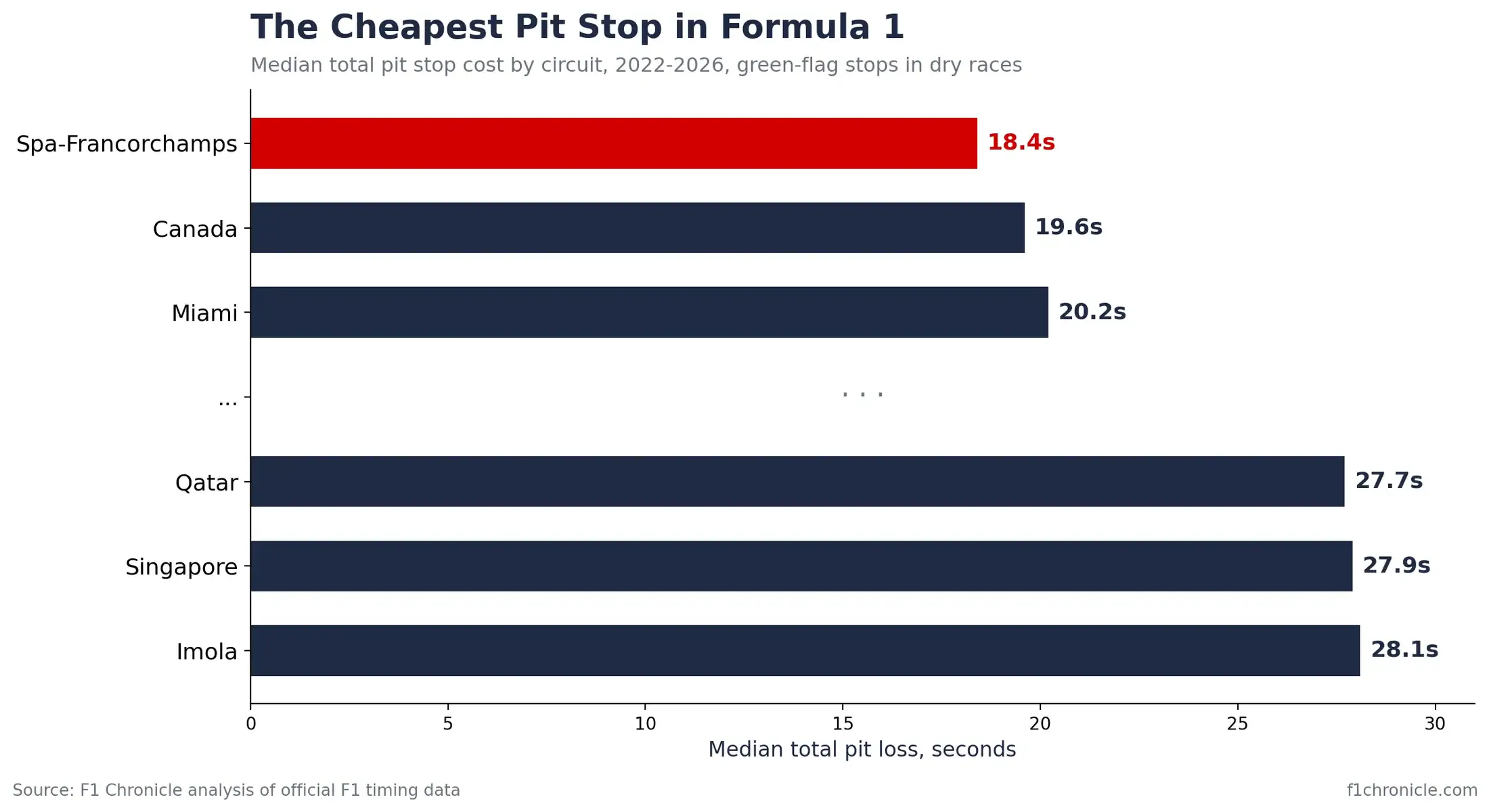
Measured against each driver’s own pace across every dry race from 2022 to 2026, a green-flag pit stop at Spa costs a median of 18.4 seconds, the lowest figure of any circuit in the dataset and nearly ten seconds cheaper than the era’s dearest pit lane at Imola. The number is freakishly stable, 18.10 in 2023, 18.46 in 2022, 18.64 in 2024, and the era’s cheapest measured stop of all happened here: 15.1 seconds. Eleven of the fifteen cheapest stops in five seasons of data belong to this one circuit.
The reason is geometry rather than heroics. Spa’s pit lane cuts off the La Source hairpin complex, so while a pitting car trundles through the lane at the limit, its rivals are negotiating the slowest corner on the circuit. A pit lane is only expensive relative to the track it bypasses, and Spa’s bypasses more valuable real estate than anywhere in Formula 1. The full circuit-by-circuit pit stop pricing shows Spa as the outlier in the friendly direction.
A 71 Percent Undercut
Forty-eight undercut attempts at Spa survive the filters across the era, and 34 of them worked: a 71 percent success rate with a median gain of 0.84 seconds. The gain is modest by the standards of Las Vegas or Bahrain, but the reliability is the point. A cheap stop lowers the cost of trying, and the long run to Les Combes gives fresh tyres a full sector of high-speed track to do their work before the first real defensive corner arrives. The biggest measured Spa undercut of the era swung 10.8 seconds in 2022, though the typical one is a scalpel rather than a hammer: enough to clear a rival, rarely enough to clear a train.
The Hard Tyre’s Best Chance All Season
Here is the genuine experiment. Historically, Spa punishes soft rubber like almost nowhere else: our era data has softs degrading at 0.100 seconds per lap of tyre age here against 0.060 for the hard, one of the steepest compound splits on the calendar, driven by the sustained loads of Pouhon, Eau Rouge and the long full-throttle climbs. But the 2026 season has turned the sport’s tyre logic upside down: as our 2026 tyre degradation data showed, the hard now wears fastest and the soft slowest, because the lighter, lower-downforce cars cannot push enough energy into a hard compound to bring it into its window.
Spa is the one circuit on the calendar built to feed the hard tyre the energy it has been starving for. If the 2026 inversion survives this weekend, it survives anywhere, and the converged range is the season’s defining tyre story. If instead the hard comes alive through Pouhon and the traditional hierarchy reasserts itself for one weekend, that is the first crack in the convergence, and the first evidence that the order flips back as loads rise. Either result is a finding, and we will measure it either way on Monday.
Can Spa Break the One-Stop Season?
The strategic stakes are bigger than one race. The paddock has spent 2026 openly worrying about a season of processional one-stop races, a direct consequence of tyres that wear too slowly and too evenly to force a second visit to the pits. A second stop only happens when its cost is lower than the pace it buys, and Spa cuts that cost further than any circuit in Formula 1. An 18.4 second toll, a 71 percent reliable undercut, and a track where fresh-tyre pace converts into overtakes down the Kemmel Straight: if the one-stop pattern breaks anywhere this season, the data says it breaks here.
The honest caveat comes from the dataset itself. The 2025 Belgian Grand Prix contributed no clean green-flag stops at all, its pit windows swallowed by the weather and the caution periods Spa produces so reliably. Every number in this preview assumes a dry, green race, and this is the circuit where that assumption goes to die. Rain does not invalidate the analysis; it simply replaces it with a different race entirely.
What to Watch on Sunday
Three checkpoints, each measurable. First, stint lengths on the hard tyre: if hards are running long and stable through the middle of the race, the 2026 inversion is bending at Spa. Second, the lap-eight-to-fifteen window: with an 18.4 second toll, the undercut threat opens early, and the first genuine attempt tells you whether the pit walls have read the same numbers we have. Third, the two-stop count: anything more than a handful of deliberate two-stoppers is the one-stop season cracking exactly where the data said it should…
Want more F1Chronicle.com coverage? Add us as a preferred source on Google to your favourites list for the best F1 news and analysis on the internet.
For more F1 news and videos, follow us on Microsoft Start.
New to Formula 1? Check out our Glossary of F1 Terms, and our Beginners Guide to Formula 1 to fast-track your F1 knowledge.
Belgian Grand Prix Data: FAQs
How much time does a pit stop cost at Spa?
A median of 18.4 seconds of race time across 2022-2026, the cheapest of any circuit in Formula 1, measured against each driver’s own pace on green-flag stops in dry races. The era’s single cheapest stop, 15.1 seconds, also happened at Spa.
Does the undercut work at Spa?
Yes, more reliably than almost anywhere: 71 percent of the 48 measured attempts from 2022 to 2026 gained time, with a median swing of 0.84 seconds. The gains are moderate, but the cheap pit stop and the run to Les Combes make it a low-risk, high-frequency weapon.
How many pit stops will there be at the Belgian Grand Prix?
The 2026 season has trended heavily toward one-stop races because the current tyre range wears slowly and evenly. Spa’s uniquely cheap pit stop makes it the most likely circuit on the calendar to tempt teams into two, weather permitting.
Which tyres are best at Spa?
Historically the hard, which degrades at 0.060 seconds per lap here against 0.100 for the soft in our era data. In 2026 that ordering has inverted across the season, with the hard wearing fastest, and Spa’s high-energy corners are the best test yet of whether that inversion holds.
More F1 Reading
- What Does an Exclamation Mark Next to a Driver’s Name Mean in F1?
- How F1 Fans Can Join The Spirit Of Competition From Home
- Apple Secures Exclusive Formula 1 Rights As Services Revenue Hits Record High
- Derek Warwick Suspended From Canadian GP Stewarding Duties

Comments
More in News

Toto Wolff Reveals Striking Details of Mercedes Leadership Succession Plan

“He’s on a Discovery Mission” – Toto Wolff Reveals Kimi Antonelli’s Unusual Mindset on the Verge of Championship Glory

“I Can Be That As Well” – Charles Leclerc on Becoming an On-Track Animal Like Max Verstappen After ‘Exciting’ COTA Battle

“We Should Just Start Communicating in Sign Language” – Max Verstappen Frustrated After Facing Radio Issues Again at COTA
