
2026 Belgian Grand Prix Fast Facts: Tyres, Track and the Numbers That Decide Spa

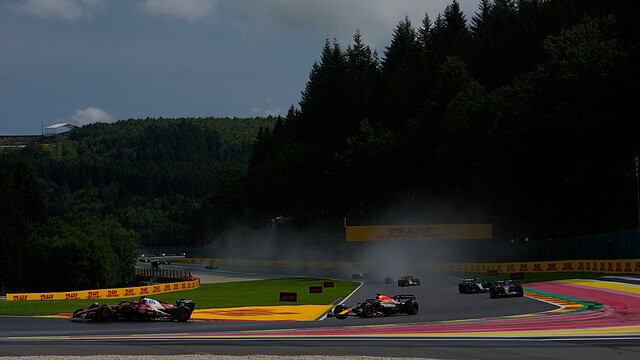
The Belgian Grand Prix runs this weekend at Spa-Francorchamps, the longest lap in Formula 1 and the penultimate round before the summer break. Pirelli has nominated the C2, C3 and C4 compounds, the harder end of its range, for a circuit that punishes tyres through sustained high-speed loads, and the supplier’s own preview points to rising track temperatures and a genuine chance of two-stop strategies. Here is everything worth knowing before lights out, from the tyre nomination to the microclimate, plus the numbers behind the strategy calls.
Spa-Francorchamps Circuit
- Spa-Francorchamps Circuit length: 7.004km, the longest of the season, with the calendar’s greatest elevation change and 19 corners.
- Tyre nomination: C2 (hard), C3 (medium), C4 (soft), the harder end of Pirelli’s range.
- The circuit was fully resurfaced two years ago and typically offers low grip early in the weekend, though June’s 24 Hours of Spa has laid extra rubber this time.
- Track temperatures at that 24-hour race exceeded 55 degrees, and Pirelli expects higher thermal degradation if the heat returns, raising the odds of two-stop races.
- Spa hosts the cheapest pit stop in Formula 1, a measured 18.4 second median cost, which lowers the bar for a second stop further than any circuit on the calendar.
The Tyres: Hard Compounds, Higher Temperatures
Pirelli’s nomination brings the C2, C3 and C4 to a circuit it rates among the most demanding for tyre loads, short of only the Suzuka and Silverstone class. The supplier expects the two hardest compounds in the range to carry Sunday’s race, and flags that if track temperatures approach the 55-degree-plus values seen during June’s 24 Hours of Spa, thermal degradation will climb and two-stop strategies become realistic.
That expectation collides with this season’s strangest measured finding. The 2026 tyre degradation data shows the hard compound wearing fastest and the soft slowest, the first inversion of the hierarchy in the ground-effect era, because the lighter, lower-downforce cars struggle to bring hard rubber into its working window. Spa’s sustained loads through Pouhon and the Eau Rouge climb are the best energy source the hard tyre has been offered all season. If Pirelli’s hard-compound race unfolds as expected, this weekend doubles as the sternest test yet of whether the inversion survives contact with a genuine high-load circuit.
The Strategy: A Cheap Stop and a Reliable Weapon
Any two-stop temptation gets a helping hand from the pit lane itself. Spa hosts the cheapest pit stop in Formula 1, an 18.4 second median cost across five seasons of measured data, because the lane bypasses the La Source hairpin complex. And once a team commits to stopping, the undercut succeeds 71 percent of the time here, the most reliable strike rate of almost any circuit measured. Cheap stop, dependable undercut, and a supplier openly predicting elevated degradation: if the one-stop pattern that has defined 2026 breaks anywhere, the ingredients are all on the table this weekend. The full strategic picture, circuit by circuit and number by number, sits in the Belgian Grand Prix data preview.
The Track: Three Circuits in One Lap
Spa’s three sectors read like three different circuits, which is why teams describe the setup task here as a compromise hunt. The first sector is the fastest, built around the long run where most of the overtaking happens. The second is the technical heart, medium-speed corners threading downhill through the forest. The third flows back uphill toward the line on a gentle gradient. Pirelli notes that 2026’s new aerodynamics ease the old dilemma: cars can carry more downforce for the technical middle sector while straight-line mode strips drag on the long runs, and, as Silverstone showed, how efficiently drivers recharge and deploy the power unit will shape the racing as much as raw pace.
The Eau Rouge and Raidillon sweep remains the signature stretch, corners arriving in quick succession and opposite directions as the road climbs toward the Kemmel Straight, and the asphalt through that section now carries grooves cut to improve drainage and visibility in the wet.
The Weather: The Ardennes Lottery
The Ardennes forest generates its own microclimate, and rain-laden cloud clears the valley slower than it does the surrounding region, so a wet Spa stays wet. When rain does arrive it rarely arrives evenly: a 7km lap means one sector can be soaked while another is dry, turning the slick-versus-intermediate call into the most delicate decision of the weekend. The history backs the caution, from the 2021 non-race to a 2025 Belgian Grand Prix that produced not a single clean green-flag pit stop in five seasons of measured data. Every strategic number above assumes a dry race, and Spa is where that assumption goes to die more often than anywhere in Formula 1.
Belgian Grand Prix: Fast Facts
- At 7.004km, Spa-Francorchamps is the longest track on the F1 calendar. As a result, the race is run over the shortest number of laps of the year: 44.
- The run down to the first braking zone at Turn One (La Source) is one of the shortest of the season at just 150m. Only Azerbaijan (90m) and Las Vegas (111m) are shorter.
- The tow at Spa-Francorchamps is very powerful due to the long straights, particularly the section after Raidillon. On the first lap this is even more powerful, because drivers chasing can pick up a tow from multiple cars.
- Tyre duty and wear are some of the highest of the season at Spa, with high averages across all four corners of the car.
- The Belgian Grand Prix is back to the traditional weekend format this year after hosting a Sprint weekend last year.
- The event forms part of Spa’s new long-term rotation agreement with Formula One, securing the Belgian Grand Prix’s place on the calendar through 2031 on selected years.
- Isack Hadjar won the FIA Formula 2 feature race at Spa in 2024, taking victory ahead of his fellow F1 graduate Gabriel Bortoleto by less than two seconds.
- A podium for Oracle Red Bull Racing this weekend would see the Team reach 300 in their F1 history, a number only previously reached by four constructors (Ferrari, McLaren, Mercedes and Williams).
- Max Verstappen has been fastest in Q3 at Spa in four of the past five years, although grid penalties have denied him the opportunity to start from Pole since 2021. His leading margins in those four Qualifying sessions were 0.321s, 0.632s, 0.820s and 0.595s.
Want more F1Chronicle.com coverage? Add us as a preferred source on Google to your favourites list for the best F1 news and analysis on the internet.
For more F1 news and videos, follow us on Microsoft Start.
New to Formula 1? Check out our Glossary of F1 Terms, and our Beginners Guide to Formula 1 to fast-track your F1 knowledge.
More F1 Reading
- Spa-Francorchamps Circuit Guide: Every Corner of F1’s Longest Lap
- F3 Belgium Wrap; title rivals collide, Nakamura’s first win & Rivera charges to Feature victory
- F2 Belgium Wrap; Tsolov’s streak snapped, Invicta sweep Spa & León’s bizarre disqualification
- 2015 Belgian Grand Prix, Where Romain Grosjean Scored His Last F1 Podium!

Comments
More in News

Toto Wolff Reveals Striking Details of Mercedes Leadership Succession Plan

“He’s on a Discovery Mission” – Toto Wolff Reveals Kimi Antonelli’s Unusual Mindset on the Verge of Championship Glory

“I Can Be That As Well” – Charles Leclerc on Becoming an On-Track Animal Like Max Verstappen After ‘Exciting’ COTA Battle

“We Should Just Start Communicating in Sign Language” – Max Verstappen Frustrated After Facing Radio Issues Again at COTA
