
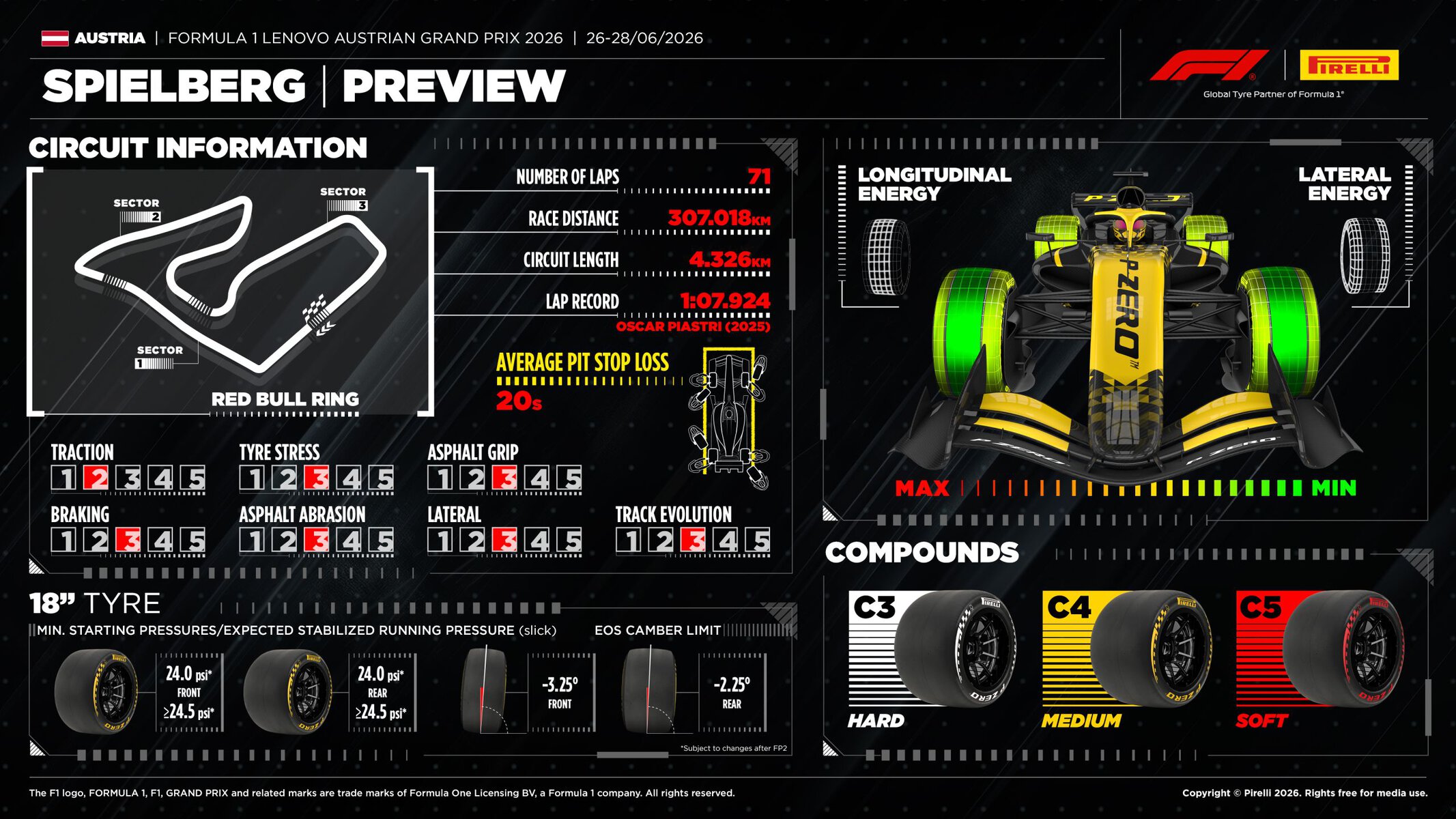
The Red Bull Ring near Spielberg is a 4.326 km layout with just 10 corners, making it the shortest track on the current F1 calendar by lap time. It sits 660 metres above sea level in the Styrian mountains and is classified as a stop-and-go circuit, where braking and acceleration phases follow in quick succession. The altitude reduces air density, which in turn lowers aerodynamic downforce on the cars and can lead to increased tyre slip. After three consecutive Sprint format weekends, the Austrian Grand Prix returns to the standard non-Sprint format for 2026.
Pirelli Tyre Strategy at Spielberg
Pirelli has nominated the softest compounds in the range for Austria: C3 as the Hard, C4 as the Medium, and C5 as the Soft. Wear is not a decisive factor at the Red Bull Ring, where degradation is mainly thermal in origin. The asphalt is several years old and features high levels of micro- and macro-roughness which generates heat in the tyres. Grip is good thanks to the rubber laid down by the numerous motorsport events hosted by the circuit throughout the year and improves over the course of the weekend, as the track evolves significantly and enhances car performance.
The traction zones place particular stress on the rear tyres, which are more prone to degradation. Drivers will also need to pay close attention to the front axle under downhill braking. The circuit’s 63 metres of elevation change means cars encounter steep descents between corners, and the new power units could deliver enough power to induce locking precisely under these downhill braking phases. At over 600 metres of altitude, the thinner air results in lower downforce, which may further increase tyre slip.
In 2025, most teams completed the race with two pit stops and all three nominated compounds were used during the Grand Prix. Soft and Medium were the main choices on the starting grid: five drivers opted for the C5, while the others selected the C4. The drivers who finished on the podium completed their middle stint on the Hard compound before reaching the chequered flag on Medium tyres. Strategies across the rest of the field varied based on the sets of tyres available for Sunday. With the greater consistency of the current tyres, a stronger trend towards a one-stop strategy could be expected this year.
Late June temperatures in Styria can approach Barcelona levels, and track temperatures at Spielberg have previously been recorded as high as 55.1 degrees Celsius, making it one of the hottest surfaces on the calendar. The mountainous terrain and surrounding forests can also create conditions for sudden weather changes, adding another variable to tyre strategy decisions.
Red Bull Ring Circuit Profile and Engineering Challenges
With just 10 corners, the Red Bull Ring has the fewest of any track on the current F1 calendar. Turns 2, 5, and 8 are taken at full throttle and are not considered corners in an engineering sense, leaving only seven genuine braking events per lap. The circuit has a steep gradient from track edge-to-edge in places, particularly at Turns 3 and 4. The track slopes up towards the apex as the car drives over the crest while accelerating out of the corner, which can result in one wheel leaving the ground and creates challenges with braking, stability, and traction.
Teams must apply significant cooling levels to the brakes because of these demands, which poses a challenge in warming up the front tyres. With a short out-lap, getting the fronts into the right operating window for a qualifying lap is difficult. Max Verstappen holds four Austrian Grand Prix victories and is bringing a fresh development package to the Red Bull Ring this weekend: “Austria is of course a home Grand Prix for the Team. It’s been a great track for me in the past and we have had really good memories there. It’s a very interesting track and all of the corners are quite different, so it’s really important to get a good balance out of the car. You need both the high speed and low speed performance, good traction and now, with how energy sensitive some tracks are, it is important to work to get on top of this. We have a new package we are bringing, so it is exciting to see how much this could look to give us in lap time. I will also be wearing my Orange Lion helmet for Austria, Belgium and Hungary as a tribute to the fans who have supported me throughout my career. So this is exciting and we are looking forward to see what we can do at the Red Bull Ring.”
Team Preparations for the Austrian Grand Prix
Mercedes have won the opening six races of 2026 but arrive in Austria under pressure, with reliability problems costing points across both cars in recent rounds.
Team principal Toto Wolff was candid about where the team stands heading into Spielberg: “Barcelona acted as a benchmark for our current performance and, having won the first six races, offered a reality check. Others have gained ground quickly and we need to respond. We are in a fight for both championships but must improve if we want to come out on top come the end of the season. Our Achilles heel so far has been reliability. We have lost a large amount of points across both cars in recent races; if we don’t put together clean weekends, our competitors will happily take advantage. We are not standing still in our efforts; we will bring a few updates to Austria this weekend with a focus on improving both performance and reliability. The margins are tight, and will be even tighter around Spielberg given the length of the lap. We need to put together a better weekend than we have in recent races but if we can deliver to our maximum, then we know we can challenge for victory.”
Austrian Grand Prix Statistics and History
The 2026 edition will be the 39th staging of the Austrian Grand Prix. The first race was held at Zeltweg in 1964 before the event moved near its current location in 1970. Eighteen editions took place at what was then known as the Österreichring until 1987, and subsequent races were held after a ten-year hiatus. Formula 1 also staged two editions of the Styrian Grand Prix at the Red Bull Ring in 2020 and 2021, organised to address calendar challenges during the Covid-19 pandemic.
Max Verstappen is the most successful driver at the Austrian Grand Prix with four victories, one more than Alain Prost. McLaren is the most successful constructor with seven wins, followed by Ferrari and Mercedes on six each. Niki Lauda remains the only Austrian driver to have won the Austrian Grand Prix, winning in 1984. George Russell’s triumph in 2024 gave him victories at the Red Bull Ring in Formula 3, Formula 2, and Formula 1.
Austrian Grand Prix Fast Facts
- After holding three Sprint format weekends, the Austrian Grand Prix returns to the non-Sprint format weekend for this year
- With just 10 corners, Spielberg has the fewest of any track of the current F1 circuits. At the same time, Turns 2, 5 and 8 are taken at full throttle and are therefore not considered to be corners in an engineering sense.
- The difference in elevation of 69 metres between the lowest and highest points at the circuit is one of the largest of the season. That is unsurprising given the track’s location in the Styrian mountains.
- It also has a steep gradient from track edge-to-edge in places, as exemplified by Turns 3 and 4. The circuit here slopes up towards the apex as the car drives over the crest while accelerating out of the corner. This can result in one wheel leaving the ground, causing challenges with braking, stability, and traction.
- For that reason, teams must apply significant cooling levels to the brakes. That poses a challenge in warming up the front tyres. With a short out-lap, it is a challenge to get them in the right operating window for a qualifying lap.
- With a maximum previously-recorded track temperature of 55.1 degrees, the surface in Spielberg can be one of the hottest of the season.
- Niki Lauda is the only Austrian driver to have won the Austrian Grand Prix, in 1984.
- George Russell’s triumph in 2024 means he has won at the Red Bull Ring in F3, F2, and F1.
- Kimi Antonelli drove an F1 car for the very first time at the circuit in 2024, when he tested the Mercedes F1 W12 from the 2021 season.
- From 2020 to 2024, Max Verstappen took Pole at Red Bull Ring on each occasion, enjoying the longest Pole-setting streak of his career at one circuit (5).
- Verstappen has led more laps at Red Bull Ring (338 laps) than at any other circuit in F1.
- Red Bull Ring is the highest European track on the current calendar at 700 meters above sea level.
Want more F1Chronicle.com coverage? Add us as a preferred source on Google to your favourites list for the best F1 news and analysis on the internet.
For more F1 news and videos, follow us on Microsoft Start.
New to Formula 1? Check out our Glossary of F1 Terms, and our Beginners Guide to Formula 1 to fast-track your F1 knowledge.
More F1 Reading
- History of the Red Bull Ring: From Österreichring to Modern F1
- Red Bull Ring Track Guide: A Corner-by-Corner Breakdown
- Liam Lawson Reveals Racing Bulls Fire Scare After Austrian GP Double Points Finish
- Max Verstappen “Wasn’t Born to Race in the Midfield”, Says Manager Amid Red Bull Speculation

Comments
More in News

Max Verstappen Says First Red Bull Engine Win Was Incredible After Hectic Bahrain Grand Prix Victory

George Russell Admits His 2026 Title Hopes Are Now Exceptionally Unlikely After Cruel Bahrain GP Retirement

Lewis Hamilton Reveals the Tyre Debate That Sank His Heart Before Remarkable Bahrain GP Recovery to Podium

Max Verstappen Claims First Win Of 2026 At Chaotic Bahrain Grand Prix
