
Are Any F1 Drivers Billionaires?
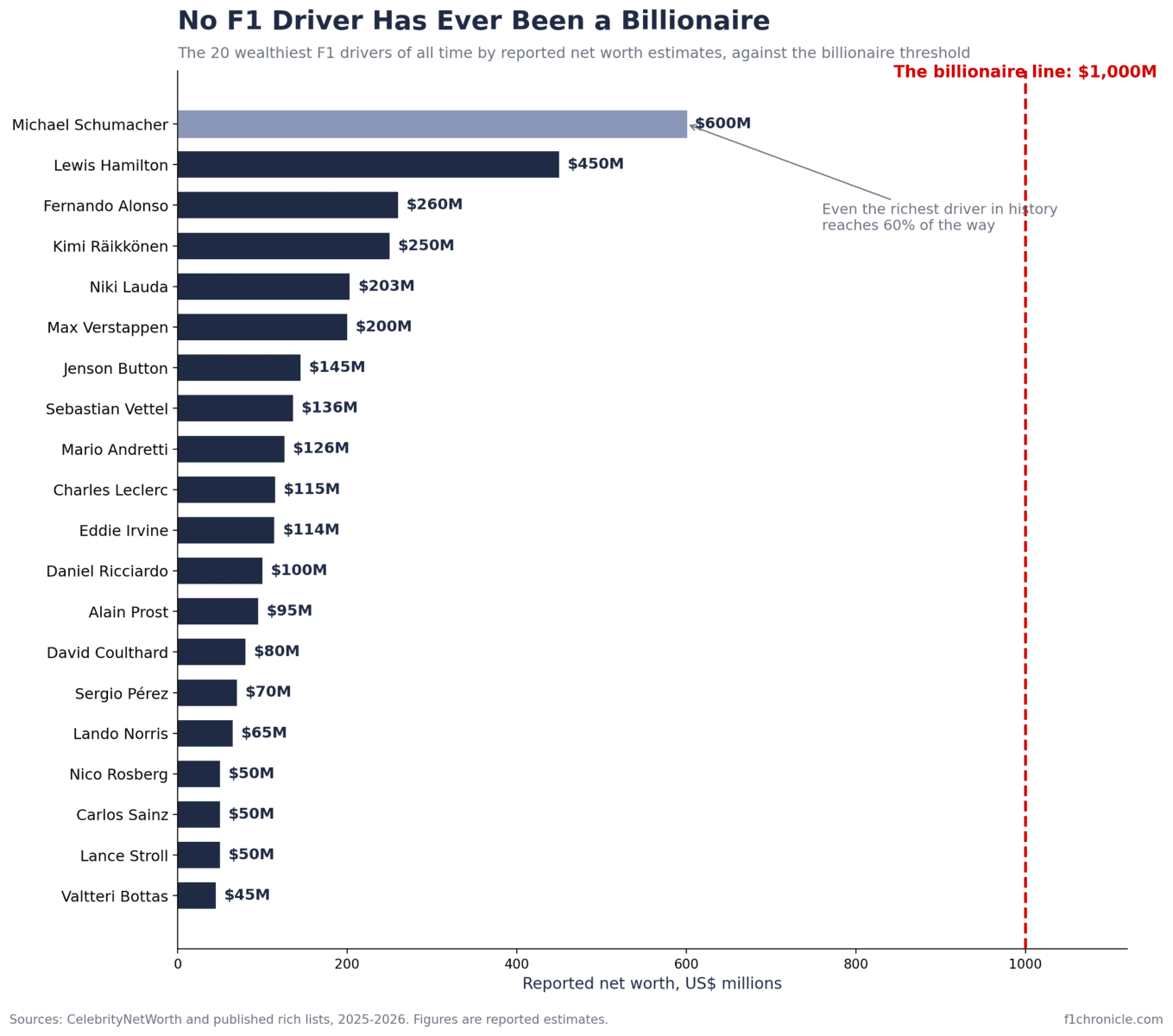
- No F1 driver, active or retired, has ever reached a net worth of one billion dollars. Michael Schumacher leads the all-time rankings at an estimated $600 million, with Lewis Hamilton second at $450 million.
- The only billionaire who ever entered a Formula 1 Grand Prix is Bernie Ecclestone, who fielded Connaughts at the 1958 Monaco Grand Prix, failed to qualify, and went on to make approximately $2.5 billion running the sport instead of driving in it.
- Hamilton’s equity investments including a Denver Broncos ownership stake and the Almave non-alcoholic spirit brand put him on the likeliest path to becoming the first F1 driver to cross the billion-dollar line, though it will almost certainly happen after he stops racing.
Watch every race of the 2026 season live on Apple TV
No F1 Driver Has Reached Billionaire Status
Are any F1 drivers billionaires? No. No Formula 1 driver has ever reached a net worth of one billion dollars through racing. Michael Schumacher tops the all-time list at an estimated $600 million. Lewis Hamilton sits second at approximately $450 million. Fernando Alonso, Kimi Räikkönen and the late Niki Lauda round out the top five between $200 million and $260 million. These are extraordinary figures by any athletic standard, but they remain hundreds of millions short of the threshold.
Even the best-paid current drivers, at an estimated $76 million a season, sit a long way from billionaire territory on salary alone.
The gap is starkest at the top: Max Verstappen’s total earnings lead the grid and still sit an order of magnitude short of billionaire territory.
The gap between the richest drivers and the billionaire line tells you something about how F1 economics work. Driving a Formula 1 car can make you one of the highest-paid athletes on the planet. It cannot, on its own, make you a billionaire. The path to a billion in this sport runs through the pit wall and the boardroom, not the cockpit.
The Richest F1 Drivers Of All Time
Schumacher’s $600 million fortune reflects seven World Drivers’ Championships, 91 Grand Prix victories, and two decades of commercial partnerships with Ferrari, Deutsche Vermögensberatung and other long-term sponsors. Hamilton’s $450 million comes from a similar combination: seven world titles, the highest sustained salary in the sport’s history at approximately $50 million per year, and an investment portfolio that extends well beyond racing.
The next tier is tightly packed. Alonso sits at $260 million, built across a career spanning more than two decades. Räikkönen accumulated $250 million through competitive salaries at Ferrari, McLaren and Lotus plus extensive sponsorship income across an 18-year career. Lauda’s $203 million reflected not only his three world titles but his airline ventures, first with Lauda Air and later with Niki. Max Verstappen, the only active driver in the top six, has reached $200 million before turning 29, driven by a Red Bull contract worth an estimated $70 million annually.
Below the $200 million line, the rankings include Jenson Button at $145 million, Sebastian Vettel at $136 million, and Mario Andretti at $126 million, whose fortune spans F1, IndyCar and decades of American motorsport. Charles Leclerc has climbed to $115 million on the back of his Ferrari contract, level with Eddie Irvine at $114 million, who built much of his wealth through property investments after retirement. Daniel Ricciardo sits at $100 million.
The lower portion of the top twenty includes Alain Prost at $95 million, David Coulthard at $80 million with extensive media and business interests, Sergio Pérez at $70 million, and Lando Norris at $65 million following his 2025 championship season. Nico Rosberg, Carlos Sainz and Lance Stroll each sit at approximately $50 million, with Valtteri Bottas at $45 million.
The Only Billionaire In F1 Entered A Grand Prix And Failed To Qualify
The only billionaire who ever entered a Formula 1 World Championship race is Bernie Ecclestone. He fielded a pair of Connaught B-Types at the 1958 Monaco Grand Prix for drivers Bruce Kessler and Paul Emery, both of whom failed to qualify. Ecclestone then drove one of the cars himself to investigate the handling problems, recording a time nearly a minute slower than his own drivers. It was not a serious attempt to race. It was an owner trying to work out what was wrong with his machinery.
His driving career ended there. He turned to team ownership, buying the Brabham team in the 1970s, then negotiated the commercial framework now known as the Concorde Agreement, giving him authority over the sport’s television contracts, hosting fees and sponsorship revenues. By the time he stepped aside, his fortune was estimated at approximately $2.5 billion. The lesson is direct: driving F1 makes you rich; owning F1 makes you a billionaire.
The Stroll family illustrates the same dynamic on a smaller scale. Lance Stroll sits on the 2026 grid with an estimated net worth of $50 million. His father Lawrence, whose fortune of approximately $3.8 billion came from fashion investments including Tommy Hilfiger and Michael Kors, bought the Force India team out of administration in 2018 and rebuilt it as Aston Martin. The billionaire in the Stroll household sits on the pit wall, not in the cockpit.
Why Driving F1 Cannot Make You A Billionaire
The salary mathematics explain why no driver has reached a billion through racing alone. Hamilton earns approximately $50 million per year in base salary at Ferrari, the highest figure any F1 driver has ever commanded. Driver salaries sit outside the budget cap, so teams can pay whatever they negotiate. But even if Hamilton sustained $50 million annually for twenty consecutive years, his pre-tax career earnings would total $1 billion. After taxes, management fees and living expenses, the net figure would be well under half that.
Endorsements add significant income but not enough to close the gap. Hamilton’s total annual compensation including bonuses and commercial deals is estimated at up to $100 million. Verstappen earned approximately $75 million in 2024. Norris banked an estimated $57.5 million in his 2025 championship year. These are among the highest-earning seasons any F1 driver has ever had, and they still leave the billionaire threshold decades away through income alone.
The athletes who have crossed the billionaire line from a playing career, including Michael Jordan, LeBron James and Tiger Woods, did it through equity stakes and business ownership that appreciated independently of their playing income. Jordan’s Nike royalties and the $3 billion sale of the Charlotte Hornets in 2023 built a $4.5 billion fortune that dwarfs his total career playing earnings of approximately $90 million. Less than 10% of Woods’s $2.9 billion comes from on-course prize money. The pattern is consistent: a salary, no matter how large, cannot compound the way an ownership stake does.
Will An F1 Driver Ever Become A Billionaire?
Probably. And it will almost certainly be Hamilton, after he stops driving. He purchased a minority stake in the Denver Broncos NFL franchise in 2022, joining the Walton-Penner group that acquired the team for $4.65 billion. He launched the Almave non-alcoholic agave spirit brand in 2023. He holds equity positions in fashion, music and technology ventures that are structured as ownership stakes, not endorsement deals, meaning their value can grow independently of his racing career.
If those investments follow the trajectory of comparable athlete-owned brands and equity positions, Hamilton’s post-racing net worth could approach a billion within a decade of retirement. The model is LeBron’s: build the playing-career fortune into the hundreds of millions, then convert it into equity that compounds on its own timeline.
The current generation of drivers is setting a higher earnings baseline than any before it. Verstappen’s $70 million annual salary and Norris’s rapid rise to $57.5 million in a championship year mean the next wave of retirees will start their post-racing lives with significantly more capital to deploy than Schumacher or Hamilton had at the same career stage. Whether any of them builds an investment portfolio on top of their racing earnings depends entirely on decisions made outside the car. The Constructors’ Championship determines how much money flows to teams each season, but what drivers do with their share of it determines whether F1 eventually produces its first billionaire from the cockpit.
How These Figures Are Counted
Every net worth figure above is an estimate, and the estimates disagree. Hamilton appears anywhere from $285 million to $450 million, depending on the source. Prost ranges from $95 million to $185 million. Rosberg sits at $30 million in some lists and $50 million in others. The figures used here are the most-cited recent estimates from sources published between 2025 and 2026.
F1 teams and drivers do not publicly disclose contract terms, investment returns or total assets. The figures are compiled by third-party outlets using reported salaries, estimated endorsement income, known business interests and public records where available. Treating any single number as definitive would be misleading. The rankings reflect the best available consensus, not verified financial disclosures.
Sources
- Formula 1’s Highest-Paid Drivers 2025 – Forbes
- Lewis Hamilton joins Denver Broncos ownership group – ESPN
- Bernie Ecclestone – Wikipedia
- Lawrence Stroll – Forbes
Want more F1Chronicle.com coverage? Add us as a preferred source on Google to your favourites list for the best F1 news and analysis on the internet.
For more F1 news and videos, follow us on Microsoft Start.
New to Formula 1? Check out our Glossary of F1 Terms, and our Beginners Guide to Formula 1 to fast-track your F1 knowledge.
Read this article in: Deutsch | Español | Français | Italiano | Nederlands | Português
More F1 Reading
- How F1 Fans Can Join The Spirit Of Competition From Home
- Apple Secures Exclusive Formula 1 Rights As Services Revenue Hits Record High
- Derek Warwick Suspended From Canadian GP Stewarding Duties
- F1’s Biggest Movers and Shakers After Barcelona Test

Comments
More in News

Max Verstappen Says First Red Bull Engine Win Was Incredible After Hectic Bahrain Grand Prix Victory

George Russell Admits His 2026 Title Hopes Are Now Exceptionally Unlikely After Cruel Bahrain GP Retirement

Lewis Hamilton Reveals the Tyre Debate That Sank His Heart Before Remarkable Bahrain GP Recovery to Podium

Max Verstappen Claims First Win Of 2026 At Chaotic Bahrain Grand Prix
