
The 2026 Canadian Grand Prix takes place on 22 to 24 May at the Circuit Gilles Villeneuve, a semi-permanent circuit on Ile Notre-Dame in the St. Lawrence River. This is the fifth round of the 2026 World Championship and the first time Montreal has hosted both a Sprint race and a May date on the Formula 1 calendar.
The combination of a compressed weekend format, cooler temperatures than the traditional June slot, and a track surface that starts the weekend with almost no racing rubber creates a set of variables that no team has encountered at this venue before.
Mercedes leads both championships with Kimi Antonelli on 100 points after three consecutive victories, but the chasing pack closed ground in Miami…
How Will the First-Ever Montreal Sprint Affect Race Strategy?
The Sprint format compresses the entire weekend into a structure that gives teams just one hour of free practice before Sprint Qualifying on Friday afternoon. At a circuit where drivers typically build confidence over multiple sessions, learning where they can attack the kerbs and where the Wall of Champions punishes aggression, that single practice hour changes the competitive dynamic. Drivers who find their rhythm early on Friday will carry a significant advantage through both the Sprint and the Grand Prix. Those who need time to dial in setups, particularly teams bringing major upgrades like Mercedes and Cadillac, face a real risk of arriving at Sprint Qualifying with an unoptimised car.
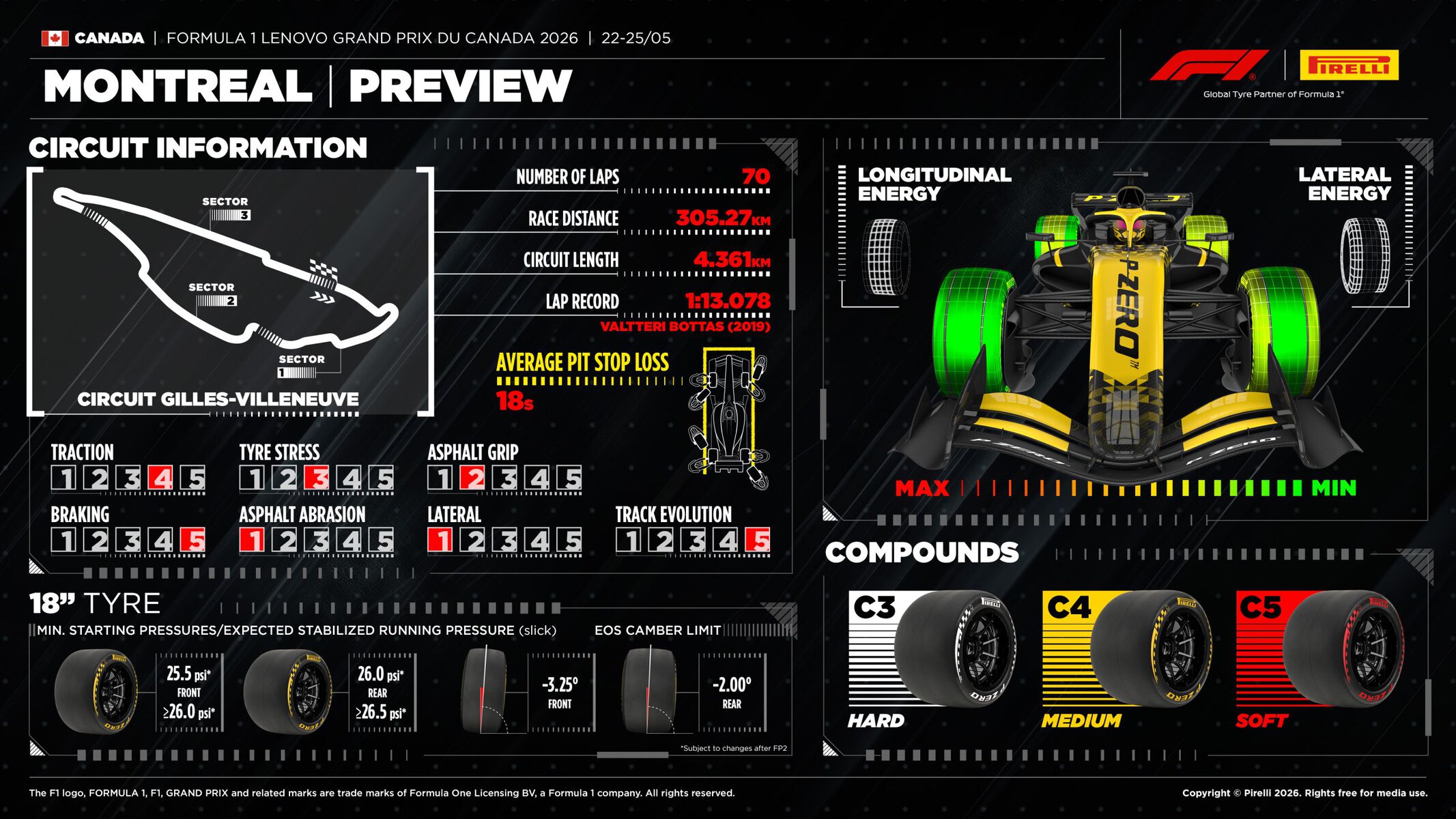
The 23-lap Sprint on Saturday serves a dual purpose. It is a points-scoring race in its own right, but it also functions as the most valuable data session of the weekend. Teams will see exactly how the C4 Medium and C3 Hard compounds behave under full race loads and in the cooler May temperatures, information that Friday practice alone cannot provide. That data feeds directly into Sunday’s strategy calculations. If the Sprint reveals that the 2026 compounds suffer less graining than expected in cooler conditions, the one-stop strategy that was marginal in previous years could become viable for a larger portion of the grid. If degradation is worse than the models predict, teams will need to recalibrate overnight.
The Sprint also accelerates track evolution. The additional competitive running from Formula 1 machinery, combined with Formula 2 and F1 Academy support races throughout the weekend, will rubber the surface in faster than a standard race weekend allows. The asphalt is expected to reach a higher friction coefficient than in previous years by Sunday afternoon, which could shrink winning margins as the track becomes significantly faster across the final sessions.
Tyre allocation under the Sprint format shapes how teams approach the entire weekend. The C5 Soft is the primary weapon for both qualifying sessions and the Sprint itself, meaning teams will spend most of their Soft sets on Saturday. The expectation is that Sunday’s 70-lap Grand Prix will be contested almost entirely on the Hard and Medium compounds, with the Soft reserved for a potential qualifying-style out-lap or a late-race gamble under a Safety Car.
Championship Standings Entering Montreal
The internal battle at Mercedes defines the title race through four rounds. Kimi Antonelli has finished on the podium at every race this season and holds a 20-point lead over teammate George Russell, who has reached the podium in two of the four events. That gap is not yet decisive in points terms, but the psychological dimension is significant. Antonelli has qualified with an average grid position of 1.25 across the opening races. Russell’s average of 2.50 is strong by any measure, but it places him consistently behind a teammate who has arrived in Formula 1 performing at a level that few rookies in the sport’s history have matched.
Behind Mercedes, the fight for third in the championship is also close. Charles Leclerc is on 59 points, with Lewis Hamilton and Lando Norris tied on 51. Both McLaren and Ferrari brought significant upgrade packages to Miami and showed improved pace, narrowing the gap to Mercedes. For Hamilton, returning to Montreal adds a personal dimension to a race he has won seven times, tied with Michael Schumacher for the record. The circuit’s heavy braking zones and tyre management demands have historically suited his driving style, particularly his trail braking technique through the chicanes.
Max Verstappen’s position in seventh on 26 points, with a qualifying average of 10.25, represents one of the most dramatic competitive reversals in recent F1 history. Red Bull has struggled to adapt to the 2026 regulations, and Montreal’s stop-and-go layout, which demands precise deployment of the 350kW Manual Override Mode and effective use of the active aerodynamic system on the back straight, will test whether the team’s development trajectory has shifted since Miami.
How Will the New May Date Change Conditions in Montreal?
The shift from June to May changes the environmental baseline for the entire weekend. May temperatures in Montreal typically peak around 20 degrees Celsius, with race weekend forecasts currently projecting 17 to 19 degrees for track sessions. That is meaningfully cooler than the 25 to 30 degree range teams have encountered at the traditional June date, and the effect on tyre behaviour is direct. Cooler ambient air reduces the thermal pressure that causes compounds to overheat, which specifically benefits the C4 Medium. In the warmer conditions of the 2025 race, the Medium suffered from high degradation that limited its usefulness as a race compound. At lower temperatures, both the Hard and Medium are expected to have longer viable stint lengths, potentially shifting the optimal pit window later into the race and giving strategists more flexibility.
Pirelli expects the 2026 compounds to clear graining faster in cooler conditions, providing a more stable and predictable tyre model by Sunday. Graining, where the surface of the tyre tears and rolls into small balls of rubber, has historically been a persistent issue through to race day at Montreal. The combination of the 2024 resurfacing, the new compound construction, and lower temperatures could reduce that problem to a Friday-only phenomenon, changing the character of the race itself.
The greater strategic variable is rain. Moving the race forward into May increases the likelihood of unsettled weather, and Montreal’s island location in the St. Lawrence River creates a microclimate where conditions can shift faster than forecast models track. The current outlook projects a 60% chance of scattered showers for Sunday’s Grand Prix, with Friday and Saturday expected to remain mostly dry. If rain arrives mid-race, the consequences are compounded by the Sprint format. Teams will have had only one dry practice session and a Sprint to establish their baseline, meaning a sudden shift to intermediates or full wets introduces uncertainty that a standard race weekend would have allowed more preparation time to manage.
The combination of cooler temperatures and potential rain opens specific strategic options. A Hard-first strategy becomes viable if the C3 performs well without graining in the lower temperature range, allowing teams to stay out longer and wait for a weather window or a Safety Car. Montreal has a high probability of Safety Car interventions due to the proximity of its concrete barriers, and a Safety Car restart in cool conditions where tyres take longer to reach their operating window is a particularly dangerous moment, forcing teams to choose between holding track position on cold rubber and pitting for fresh, warm tyres.
Circuit Gilles Villeneuve: What Makes Montreal So Demanding?
The 4.361-kilometre Circuit Gilles Villeneuve layout features 14 corners connected by long straights that produce a stop-and-go rhythm unlike any other venue on the Formula 1 calendar. Seven of those corners require heavy braking from speeds above 300 km/h, and the low-downforce aerodynamic configurations teams run to maximise straight-line speed mean less aerodynamic drag to assist deceleration. The braking burden falls almost entirely on the mechanical systems, with disc temperatures approaching 1,000 degrees Celsius in the heaviest zones.
The track surface, resurfaced in 2024, is smooth and low in abrasiveness. Because the circuit is used for motor racing only during the Formula 1 weekend, with the roads open to cyclists, runners, and inline skaters as part of Parc Jean-Drapeau for the rest of the year, the surface arrives at each Grand Prix weekend with almost no embedded racing rubber. That creates a “green” track on Friday morning that evolves dramatically across the three days. The grip transformation from first practice to the race is more extreme at Montreal than at almost any other circuit, and a single rain shower overnight can wash the accumulated rubber from the surface and reset it to its original slippery state.
The final chicane and the Wall of Champions at Turn 14 remain the highest-risk sector of the lap. The 2026 regulations have introduced stiffer carbon fibre floors that are less forgiving when drivers attack the exit kerbs aggressively, and the proximity of the concrete wall to the racing line leaves no margin for error. The wall claimed Damon Hill, Michael Schumacher, and Jacques Villeneuve in a single race weekend in 1999, and it continues to punish misjudgement with immediate, race-ending consequences.
2026 Canadian Grand Prix Weekend Schedule
The weekend begins on Friday 22 May with Free Practice 1 at 12:30 local Montreal time, followed by Sprint Qualifying at 16:30. Saturday 23 May features the Sprint race at 12:00 and Grand Prix Qualifying at 16:00. The 70-lap Grand Prix starts at 16:00 on Sunday 24 May. The later afternoon start time for the race means that if the forecasted showers arrive, they are likely to coincide with the second half of the Grand Prix, creating the conditions for a dramatic strategic split between teams that pit early for wet-weather tyres and those that gamble on the rain passing.
2026 Canadian Grand Prix Fast Facts
- The Circuit Gilles-Villeneuve will host a Sprint event, the third one of the 2026 season, for the very first time.
- The 4.361 km Circuit Gilles Villeneuve shares many characteristics with a track like Baku; a combination of long straights, where low drag is crucial, with slow-speed corners such as chicanes and hairpins that demand good downforce and traction.
- This year marks the 45th Formula 1 Grand Prix held at the venue. Only Spa-Francorchamps, Silverstone, Monaco, and Monza have hosted more races on the F1 calendar, underlining Montreal’s historic importance.
- A defining feature of the circuit is its sequence of rapid direction changes, with several corners forming left-right or right-left combinations. Key examples include Turns 1-2, 3-4, 6-7, 8-9, and the final chicane (Turns 13-14). These sections place a premium on car responsiveness, stability over kerbs, and driver precision.
- The 405-metre pit lane ranks sixth longest on the calendar, but crucially, the total time lost during a pit stop is relatively low. Drivers benefit from entering the pits before the final chicane, avoiding that slower section, and rejoining at Turn 2, bypassing Turn 1 entirely.
- One of the track’s most iconic features is the lack of run-off at the exit of the final corner, famously known as the “Wall of Champions.” The name dates back to 1999, when Damon Hill, Michael Schumacher, and Jacques Villeneuve all crashed there during the same weekend.
- Lewis Hamilton and Michael Schumacher share the distinction of the most wins at the circuit, with seven victories each.
- The 2026 Canadian Grand Prix will host the second round of the F1 Academy series, and round three of the FIA Formula 2 Championship.
Want more F1Chronicle.com coverage? Add us as a preferred source on Google to your favourites list for the best F1 news and analysis on the internet.
For more F1 news and videos, follow us on Microsoft Start.
New to Formula 1? Check out our Glossary of F1 Terms, and our Beginners Guide to Formula 1 to fast-track your F1 knowledge.
More F1 Reading
- The Beer Wars That Nearly Ended the Canadian Grand Prix
- Where Is The Canadian Grand Prix Being Held? Montreal’s Island Circuit Explained
- Mastering Montreal: A Technical Guide to the Circuit Gilles Villeneuve
- Max Verstappen Reveals Why Current F1 Rules Are ‘Mentally Not Doable’

Comments
More in News

‘I Know It’s Very Close’: Kimi Antonelli Stays Focused as F1 Title Opportunity Looms

Max Verstappen Says First Red Bull Engine Win Was Incredible After Hectic Bahrain Grand Prix Victory

George Russell Admits His 2026 Title Hopes Are Now Exceptionally Unlikely After Cruel Bahrain GP Retirement

Lewis Hamilton Reveals the Tyre Debate That Sank His Heart Before Remarkable Bahrain GP Recovery to Podium
