
When Was The Halo Introduced In F1?
Article reviewed and updated by Jack Renn, July 2026
- The halo was introduced as a mandatory safety device for all Formula 1 cars from the start of the 2018 season. Made from Grade 5 titanium, the device withstands forces equivalent to 12 tonnes and is mounted to the chassis at three points around the cockpit.
- The halo has been credited with protecting drivers in multiple serious incidents, including Charles Leclerc at the 2018 Belgian Grand Prix, Romain Grosjean’s fireball crash at the 2020 Bahrain Grand Prix, and Lewis Hamilton at the 2021 Italian Grand Prix.
- Before choosing the halo, the FIA also tested the Red Bull-designed aeroscreen and a polycarbonate shield. IndyCar adopted the aeroscreen rather than the halo, while Formula 2 and Formula 3 use the same halo device as F1.
When Was The Halo Introduced In F1?
The halo was introduced in Formula 1 at the start of the 2018 season, when the FIA made the titanium cockpit protection device mandatory on every car on the grid. The curved bar sits above the driver’s head and wraps around the cockpit opening, creating a frame designed to deflect large objects and debris away from the driver’s helmet. Its name comes from the top section that arcs over the cockpit.
The decision followed years of research into head protection for open-wheel racing. The deaths of Jules Bianchi, who suffered fatal head injuries at the 2014 Japanese Grand Prix after hitting a recovery vehicle, and IndyCar driver Justin Wilson, who was killed by flying debris at Pocono Raceway in 2015, added urgency to work the FIA had already been conducting.
Mercedes proposed the halo concept during this period, and the first steel prototype was tested at RAF Bentwaters in 2015, where it successfully deflected a 20kg tyre fired from a nitrogen-powered cannon at 225 km/h. A titanium version followed at the 2016 Austrian Grand Prix, and the final production design was locked in for 2018 after two full years of track testing and refinement.
How The Halo Is Built
The halo is machined and welded from Grade 5 titanium, the same alloy used extensively in aerospace for its strength-to-weight ratio. Manufacturing begins with two titanium billets that are gun-drilled and machined into tubes, each bent to 90 degrees and welded together to form the 180-degree main hoop. The V-shaped transition piece and rear mounts are machined from titanium billet using 3-axis and 5-axis CNC milling, a process requiring extensive machining time for the transition piece. Welding is performed inside a sealed chamber to prevent contamination, and the completed assembly undergoes heat treatment for additional strengthening before a final pass on a 5-axis mill brings every surface to tolerance.
Every finished device is geometry-checked, weight-checked, and subjected to non-destructive testing including X-rays and crack tests. The FIA selected three approved manufacturers to produce the halo to a single specification shared across all teams. As Mercedes Technical Director James Allison explained when the device arrived in 2018, “The Halo is not a light piece of work. It is several kilograms of titanium that need to be put on the car.”
The production halo weighs approximately 9kg, with mounting hardware bringing the total system weight to around 13.5kg. It stands roughly 17 centimetres above the cockpit rim, sits at least 84 centimetres above the cockpit floor, and spans a minimum width of 116 centimetres. The device is secured to the car’s chassis at three points: two rear mounts behind the driver’s head and the central pillar in front.
The strength requirements are severe. The halo must withstand 125 kilonewtons of vertical force, equivalent to roughly 12 tonnes, for five seconds without any failure to the survival cell or the mountings. It must also resist 125 kN of lateral force. Allison put the requirement in more accessible terms: the crash-tested chassis beneath it had to be “strong enough to take roughly the weight of a London double-decker bus sitting on top of the Halo.”
Alternatives The FIA Considered
The halo was not the only concept the FIA evaluated. Two other designs reached the testing stage before being set aside.
The aeroscreen, developed by Red Bull Advanced Technologies, was a transparent canopy that enclosed the cockpit opening entirely. The FIA tested the concept but ultimately preferred the halo’s lighter weight and the absence of potential visibility issues caused by reflections and rain on a transparent surface. The aeroscreen did not disappear from motorsport entirely, and its story is covered below.
The shield was a polycarbonate screen that extended along the front of the cockpit without fully enclosing it. Sebastian Vettel tested the shield during practice for the 2017 British Grand Prix at Silverstone but completed only a single installation lap before asking for it to be removed. He reported significant visual distortion due to the curvature of the screen, saying “I got a bit dizzy and there was a lot of downwash down the straight, coming off the back of my helmet and pushing my head forward.” The shield was abandoned after that test, and the FIA confirmed the halo as the chosen solution.
Incidents That Proved Its Worth
Opposition to the halo was vocal before its introduction. Lewis Hamilton posted on Instagram in 2016, calling it “the worst looking mod in Formula One history.” Toto Wolff described it as “dreadful” before the 2018 season began. Fans argued that the device spoiled the appearance of open-cockpit cars, and some drivers worried about whether the central pillar would obstruct their vision through tight corners.
Those objections faded as real incidents demonstrated what the halo could do.
At the 2018 Belgian Grand Prix, a first-corner collision launched Fernando Alonso’s McLaren over Charles Leclerc’s Sauber. The underside of Alonso’s car struck the halo directly, leaving visible damage on both devices. Leclerc said afterwards that the halo “probably helped” avoid a far worse outcome. Wolff, who had been one of the device’s most prominent critics, acknowledged that the incident changed his position, saying, “even though it’s aesthetically not what I like, it’s a super initiative that has shown its merit.”
The most dramatic test came at the 2020 Bahrain Grand Prix. Romain Grosjean’s Haas hit the barriers at 192 km/h, split in half, and burst through the Armco into a fireball. Grosjean sustained burns to his hands but was able to climb out of the wreckage, a crash measured at 67g. The halo held the barrier apart long enough for Grosjean to extract himself from the cockpit, and subsequent analysis concluded that without the device, the outcome would almost certainly have been fatal.
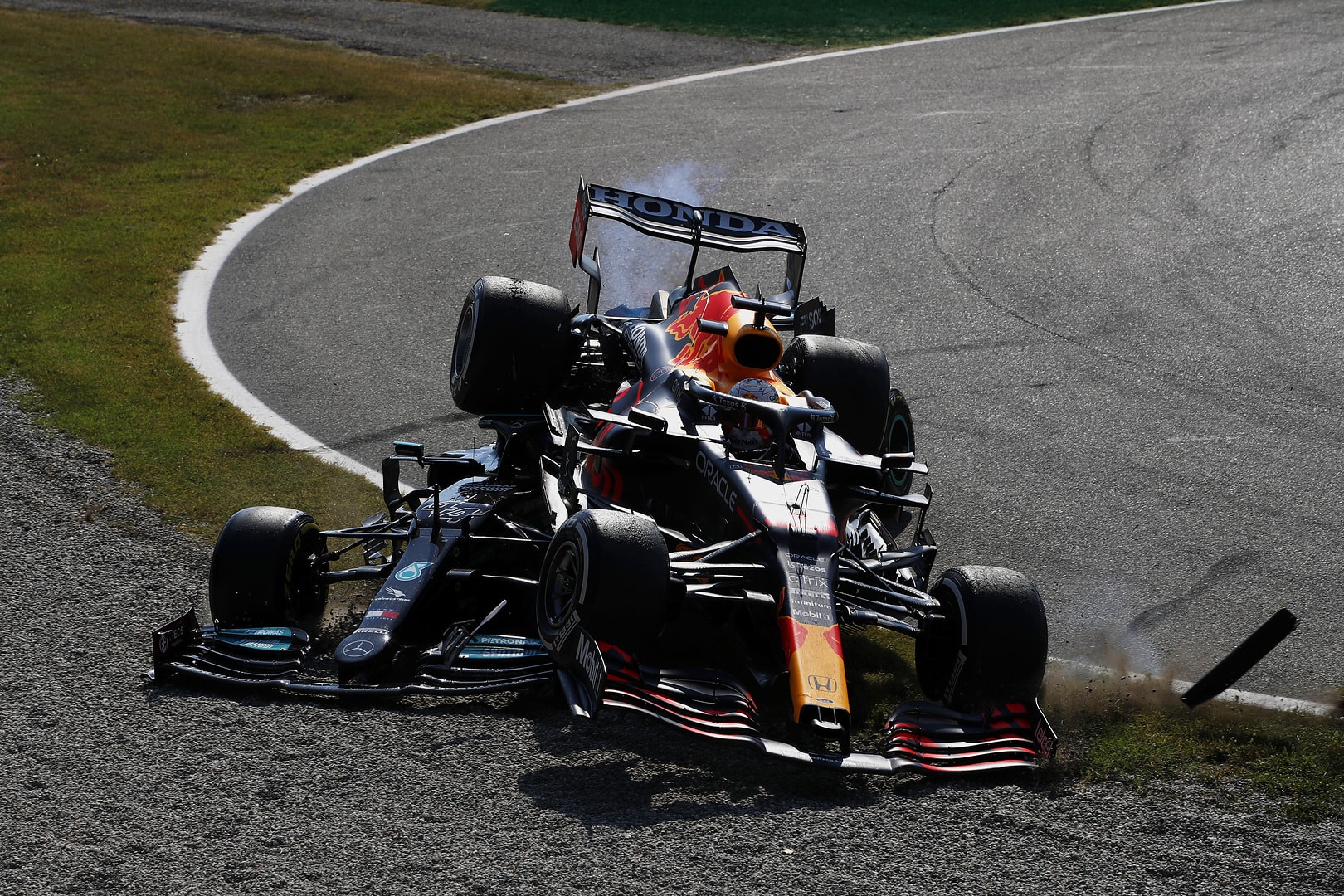
At the 2021 Italian Grand Prix at Monza, Max Verstappen’s Red Bull landed on top of Lewis Hamilton’s Mercedes after a collision at the Turn 1 chicane. Verstappen’s rear tyre came to rest directly on Hamilton’s halo, pressing down onto the titanium bar rather than striking the driver’s helmet. Hamilton, who had called the halo the worst-looking modification five years earlier, said afterward, “Thank God for the halo. That ultimately, I think, saved me, and saved my neck.”
Zhou Guanyu’s crash at the 2022 British Grand Prix provided yet another case. Zhou’s car was launched upside down on the opening lap and slid inverted across the gravel and into the barriers. The halo maintained cockpit integrity throughout, preventing the driver’s head from contacting the ground while the car was upside down.
Adoption Beyond Formula 1
Formula 2 adopted the same halo device from the 2018 season, matching F1’s implementation. Formula 3 followed in 2019 with the introduction of the Dallara F3 2019 chassis. Formula E has used the halo since its Gen2 car arrived for the 2018-19 season. The device is now standard equipment across all major FIA single-seater categories.
IndyCar took a different path. Rather than adopting the halo directly, IndyCar partnered with Red Bull Advanced Technologies to develop the aeroscreen, which entered competition in 2020. The aeroscreen uses a titanium frame similar in shape to the halo but adds a ballistic-grade polycarbonate windscreen that provides protection against smaller debris that could pass through the halo’s open structure. The IndyCar device carries a total system weight of approximately 24kg (versus 13.5kg for the F1 halo system) but can withstand approximately 150 kN of force, roughly 25 kN beyond the halo’s rating.
The HANS device and the halo now form the two primary layers of driver head and neck protection in modern single-seater racing, working alongside the survival cell, seat belts, and helmet standards that make up the full safety system.
Want more F1Chronicle.com coverage? Add us as a preferred source on Google to your favourites list for the best F1 news and analysis on the internet.
For more F1 news and videos, follow us on Microsoft Start.
New to Formula 1? Check out our Glossary of F1 Terms, and our Beginners Guide to Formula 1 to fast-track your F1 knowledge.
Formula 1 Halo FAQs
Why was the halo controversial when it was first introduced?
The main objections were visual. Critics argued that the titanium bar spoiled the look of open-cockpit cars and broke with decades of tradition. Some drivers also worried about visibility through the central pillar in tight corners, though most reported adapting within a few laps of running. Concerns about the halo slowing driver extraction in emergencies were addressed conclusively by Grosjean’s crash at Bahrain in 2020, where he escaped the burning wreckage of his car with the halo in place.
How many drivers has the halo protected?
The halo has been credited with protecting drivers in at least four high-profile F1 incidents: Charles Leclerc at Spa in 2018, Romain Grosjean at Bahrain in 2020, Lewis Hamilton at Monza in 2021, and Zhou Guanyu at Silverstone in 2022. Additional incidents in Formula 2 and Formula 3 have further demonstrated the device’s value.
Can teams modify the halo?
No. The halo is a standardised component produced to a single FIA specification by three approved manufacturers. Teams cannot alter its shape, dimensions, or mounting geometry. They can optimise the aerodynamic fairing that covers the halo, and most teams now use the top of the device as a mounting point for the forward-facing onboard camera.
Sources
- How to Make an F1 Halo – FIA
- INSIGHT: Introducing the Halo – Mercedes-AMG F1
- IndyCar announces Aeroscreen partnership with Red Bull Advanced Technologies – IndyCar
- Lewis Hamilton would remove “worst looking” F1 halo design – Sky Sports
- Halo (safety device) – Wikipedia
More F1 Reading
- How F1 Fans Can Join The Spirit Of Competition From Home
- Apple Secures Exclusive Formula 1 Rights As Services Revenue Hits Record High
- Derek Warwick Suspended From Canadian GP Stewarding Duties
- F1’s Biggest Movers and Shakers After Barcelona Test

Comments
More in News

Max Verstappen Says First Red Bull Engine Win Was Incredible After Hectic Bahrain Grand Prix Victory

George Russell Admits His 2026 Title Hopes Are Now Exceptionally Unlikely After Cruel Bahrain GP Retirement

Lewis Hamilton Reveals the Tyre Debate That Sank His Heart Before Remarkable Bahrain GP Recovery to Podium

Max Verstappen Claims First Win Of 2026 At Chaotic Bahrain Grand Prix
