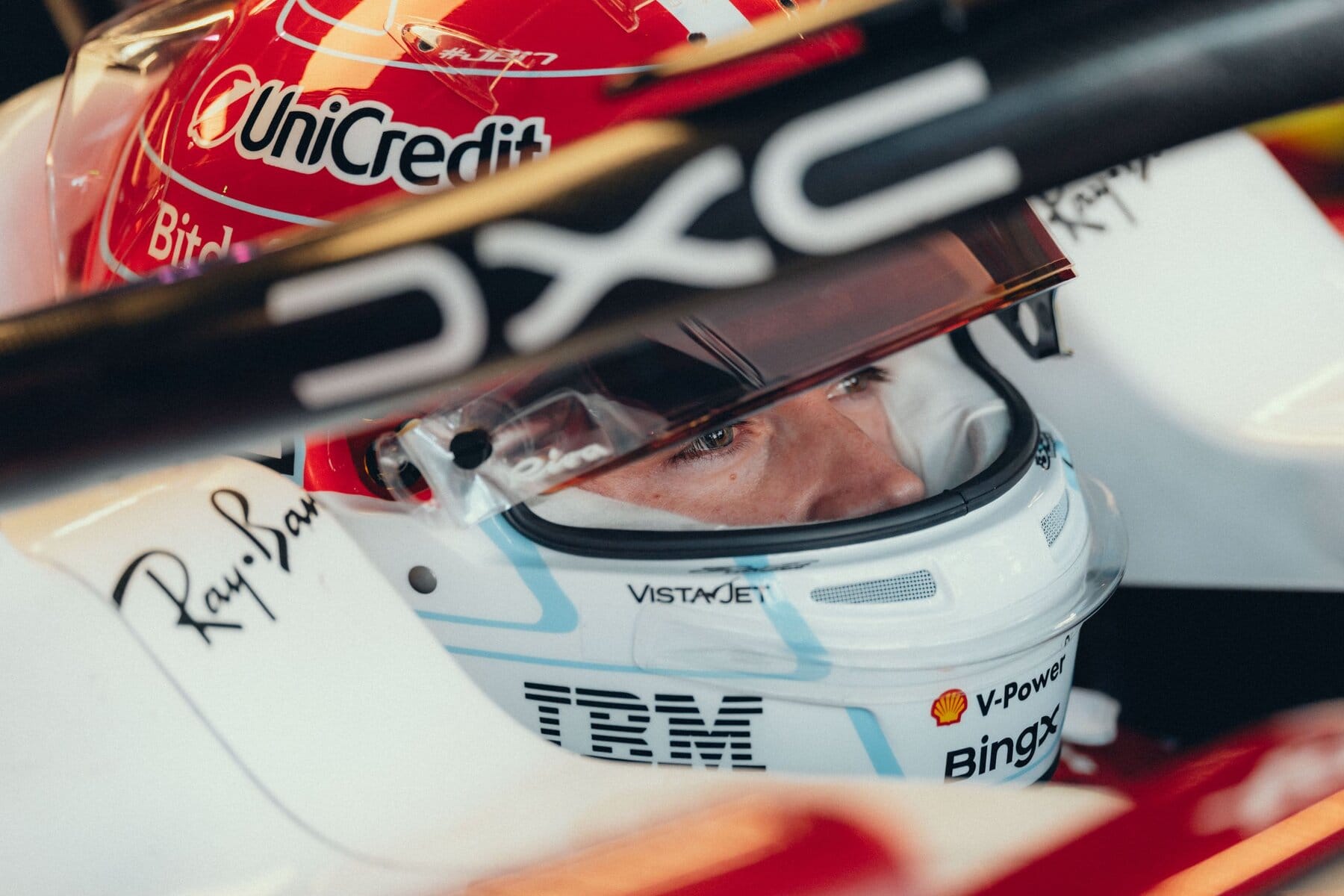
The impact was heard across the Suzuka valley before the telemetry could even register the spike. On Lap 22 of the 2026 Japanese Grand Prix, Oliver Bearman’s Haas VF-26 was transformed into a 191mph (308km/h) projectile. After a desperate, high-speed steering input to avoid a suddenly slowing car, Bearman’s machine clipped the grass, lost all aerodynamic stability, and slammed broadside into the barriers at the entry to the Spoon Curve. The recorded force was a staggering 50G, an impact more violent than Carlos Sainz’s infamous 46G shunt in Russia and nearly identical to Max Verstappen’s 2021 Silverstone crash.
While the “halo” and the reinforced 2026-spec safety cell preserved the monocoque integrity, allowing Bearman to walk away with only a right knee contusion, the paddock remains in a state of technical shock. This was not a standard case of rookie over-ambition. Instead, it was the “inevitable” collision the Grand Prix Drivers’ Association (GPDA) has predicted since pre-season testing. The incident has exposed a harrowing reality: under current regulations, two healthy cars on the same stretch of track can possess a 50km/h speed delta that makes wheel-to-wheel racing feel less like a tactical skill and more like a high-stakes evasive maneuver.
The Deadly “Delta”: The 50km/h Speed Gap
The technical genesis of the accident lies in the extreme closing speed between Bearman’s Haas and Franco Colapinto’s Alpine. In previous eras, cars in a DRS train moved with relative synchronicity. The 2026 power unit regulations, which mandate a 50/50 split between internal combustion and electrical power, have introduced radical energy discharge curves that are counter-intuitive to the sport’s history.
Approaching Turn 13, Bearman was in “Boost Mode,” using his maximum electrical deployment. Simultaneously, Colapinto’s Alpine reached its energy harvesting threshold, where the MGU-K exerts massive electromagnetic drag to replenish the battery. This created a 200kW power disparity between the two machines. As Bearman entered the Alpine’s low-pressure wake, the resulting loss of front-end downforce made his Haas hyper-sensitive to his evasive correction. Carrying 50km/h (31mph) more than the car ahead, the transition to the grass was a death sentence for his grip levels.
“It was a massive overspeed, 50kph which is a part of these new regulations that I guess we have to get used to,” Bearman reflected after being cleared by the medical center. “I think as a group we warned the FIA what can happen and this has been a really unfortunate result of a massive delta speed we’ve not seen before in F1 until these new regulations.”
“Mushroom Boosts” and “Superclips”: Racing’s New Vocabulary
The 2026 regulations have forced drivers to adopt a lexicon more suited to a video game than the top category of motorsport on the planet. Max Verstappen has been the most vocal critic, famously comparing the current era to “Mario Kart,” and the data from Suzuka reinforces his cynicism. Two terms now dominate the engineering briefings:
- Mushroom Boost: A reference to gaming power-ups, this describes the massive surge of electrical energy (350kW) that, when combined with the ICE, brings total output to a staggering 750 kilowatts.
- The Superclip: This occurs when a car instantly hits its harvesting limit or suffers a software bug (as seen with George Russell’s Mercedes during the race), causing a sudden, massive drop in longitudinal acceleration.
This volatility has fundamentally altered the nature of the overtake. Fernando Alonso noted that maneuvers are now often “accidental” or “evasive” rather than tactical. When one car is “clipping” and the other is in “mushroom” mode, the car ahead effectively “brake tests” the trailing driver. 1996 World Champion Damon Hill pointed out a critical safety flaw in this mechanism: the rear recharge lights, intended to warn following drivers of harvesting, are flashing “too late” to provide a sufficient buffer for a 50km/h speed differential.
The GPDA’s “I Told You So” Moment
For the GPDA, the Suzuka crash was a terrifying validation of concerns raised since the season opener in Australia. Director Carlos Sainz and McLaren’s Lando Norris have argued that the 2026 framework prioritizes “the show” over fundamental safety. Sainz was particularly pointed, noting that while Bearman was “lucky” to have the grass run-off and escape roads of a traditional circuit like Suzuka, the physics change entirely on street circuits.
The looming fear is the upcoming schedule. In the tight concrete canyons of Baku, Singapore, or Las Vegas, there are no grass verges to bleed off speed, only 90-degree walls. A 50km/h delta in those environments could turn a knee contusion into a tragedy.
“I hope it serves as an example and they listen to the drivers and not so much the teams,” Sainz stated. “Some people said that the racing was okay, because the racing is not okay. We were lucky there was an escape road. Now, imagine going to Baku, or Singapore, or Vegas.”
The Silver Lining: Kimi Antonelli’s Historic Ascent
The irony of the weekend is that the very chaos triggered by these regulations enabled a historic sporting moment. The Safety Car deployed for Bearman’s wreck neutralized the field and handed 19-year-old Kimi Antonelli a “free” pit stop. The Mercedes protégé capitalized, claiming his second successive victory and becoming the youngest driver to ever lead the World Championship.
Antonelli now sits atop the standings with 72 points, proof of his generational talent. Yet, the fact that his ascent was secured by a regulatory safety crisis is not lost on the veterans. The “unpredictability” the FIA sought has arrived, but it has brought with it a level of technical instability that many in the paddock find unacceptable.
The April Pivot
The FIA has officially acknowledged the role of “high closing speeds” in the accident and has moved the energy management review to the top of the agenda. A series of high-level meetings are scheduled for April to analyze the data from the opening rounds. The goal is to refine the software-controlled harvesting limits and discharge parameters before the championship resumes.
As F1 heads to the tight concrete canyons of Miami, will the FIA’s data-driven refinements be enough to prevent a high-speed tragedy, or is the 2026 era fundamentally designed for danger?
Want more F1Chronicle.com coverage? Add us as a preferred source on Google to your favourites list for the best F1 news and analysis on the internet.
From F1 news to tech, history to opinions, F1 Chronicle has a free Substack. To deliver the stories you want straight to your inbox, click here.
For more F1 news and videos, follow us on Microsoft Start.
New to Formula 1? Check out our Glossary of F1 Terms, and our Beginners Guide to Formula 1 to fast-track your F1 knowledge.

Comments
More in News
‘It’s just not what I want to do’, Max Verstappen admits there is a lot for him to figure out as F1 future decision looms
FIA acknowledge “high closing speeds” contributed to Bearman Japan shunt, but what’s going to change?
Kimi Antonelli: ‘It’s too early to think about the championship’
Oscar Piastri: ‘We did everything right and still got beaten by 15 seconds’