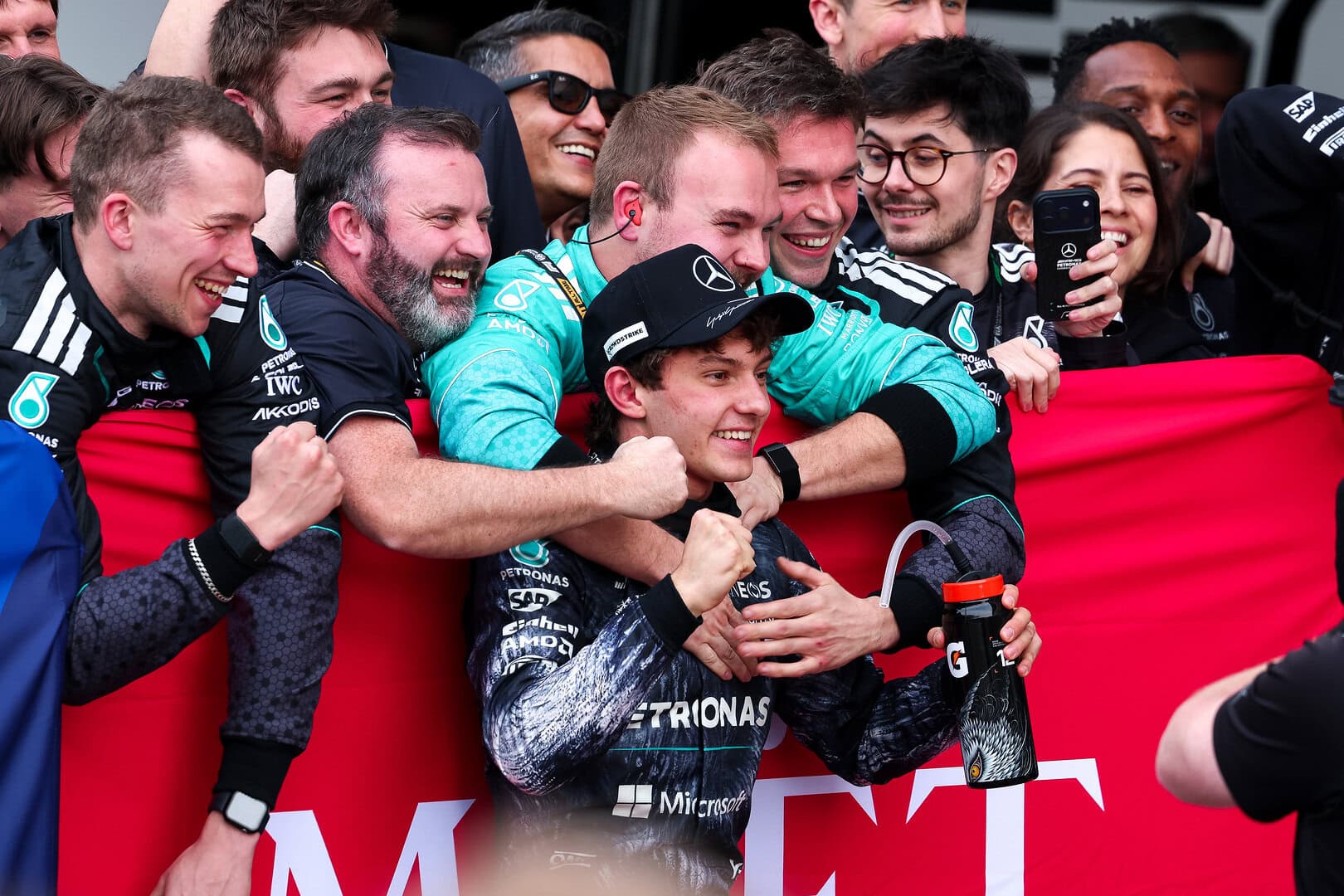
Mercedes Plans to Cut Back F1 Engine Customers
Mercedes plans to scale back the number of Formula 1 teams it supplies with power units in the coming years, according to team CEO and co-owner Toto Wolff.
In 2024, Mercedes engines powered four teams, the Mercedes works outfit, McLaren, Williams, and Aston Martin. That will change next season, as Aston Martin switches to Honda and Alpine transitions to Mercedes power. All three customer teams currently hold contracts running through 2030, but Wolff says Mercedes is rethinking its long-term supply strategy ahead of F1’s new engine regulations coming in 2026.
Mercedes Aims to Reduce Engine Customers After 2026
“Our current mindset, and something Ola [Källenius] and I have discussed, is that we will reduce the number of teams we supply in the next cycle,” Wolff told Formula 1’s official channel. He suggested the ideal number of partner teams will likely be “between two and three.”
Wolff explained that the decision will depend on several regulatory factors, including the design complexity of the new power units and how much development value Mercedes gains from supplying multiple teams.
Production Demands Put Pressure on Mercedes
With four teams using its engines, Mercedes must build and prepare 16 power units for the start of the season, far more than competitors like Honda, which supplies fewer teams.
“That means longer lead times and longer production cycles,” Wolff said. “Considering all that, going forward, it’s not going to be four anymore.”
Balancing Benefits and Drawbacks
Hywel Thomas, managing director of Mercedes AMG High Performance Powertrains, acknowledged that supplying multiple teams has clear advantages. More cars on track mean more data, more engineering feedback, and more real-world testing.
“You get four times the engineers telling you what can be improved, and that’s extremely valuable,” Thomas said. “It doesn’t always feel like it, but it helps you make a better product.”
However, he added that supporting several teams brings significant challenges. More hardware must be produced, and key decisions must be finalized earlier in the development cycle.
“There’s definitely a sweet spot,” Thomas said. “I’m not sure whether it’s one, two, three, or four teams, but it’s probably closer to four than one.”
Dominance of the Hybrid Era
Mercedes leaves the V6 hybrid era as the most successful power-unit manufacturer of the period. Its engines powered eight consecutive constructors’ titles for the works team from 2014–2021 and helped McLaren secure the 2024 and 2025 championships.
Even with that success, Mercedes appears poised to streamline its operations as Formula 1 enters a new technological era.
From F1 news to tech, history to opinions, F1 Chronicle has a free Substack. To deliver the stories you want straight to your inbox, click here.
For more F1 news and videos, follow us on Microsoft Start.
New to Formula 1? Check out our Glossary of F1 Terms, and our Beginners Guide to Formula 1 to fast-track your F1 knowledge.

Comments
More in News

‘We’re getting entertained’, Damon Hill explains why ‘tactical’ racing is putting on a show

Mario Kart in Real Life: Why the 2026 Japanese GP Crash is F1’s Ultimate Warning Sign
‘It’s just not what I want to do’, Max Verstappen admits there is a lot for him to figure out as F1 future decision looms
FIA acknowledge “high closing speeds” contributed to Bearman Japan shunt, but what’s going to change?