
Round 2 of the 2026 F1 season produced a clearer picture than Melbourne. Kimi Antonelli took pole and victory for Mercedes, Lewis Hamilton reached the podium for Ferrari for the first time, and both McLaren drivers failed to start.
The results, taken together, tell a pointed story about where each constructor stands with the new regulations.
The 2026 technical regulations, built around high-density energy deployment and reshaped aerodynamic rules, is proving far less forgiving than its predecessor. Teams that read it correctly in the winter are pulling away. Those that did not are already chasing a significant deficit…
1. The Record-Smasher: Kimi Antonelli’s Age of Dominance
Qualifying provided the first tremor. Kimi Antonelli’s 1:32.064 lap was more than a pole position; it was a record-smashing statement. At 19 years, 6 months, and 17 days, he became the youngest pole sitter in Formula 1 history.
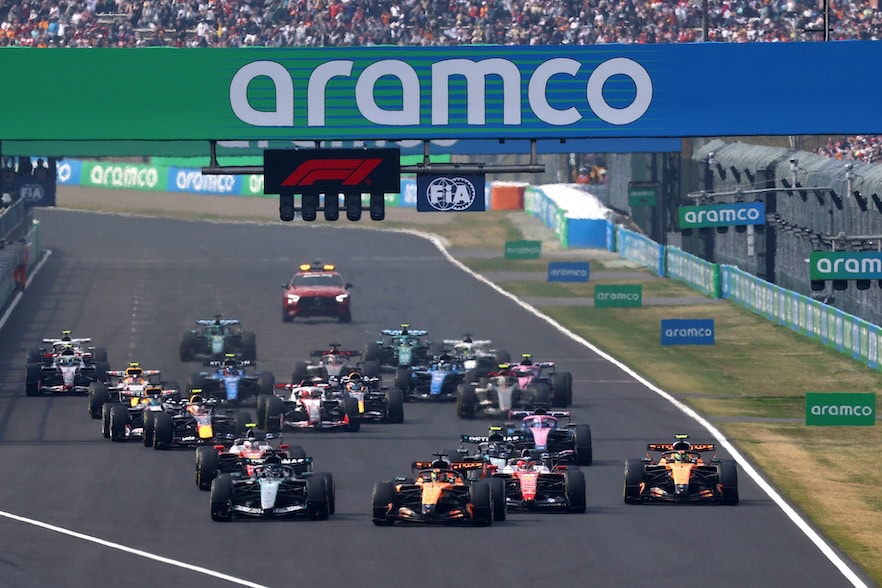
The race required temperament. After losing the lead to Lewis Hamilton’s explosive start, Antonelli maintained a chilling composure. He used the W17’s superior deployment to reclaim the lead before the end of Lap 2. By the time he crossed the line as the second-youngest winner ever, the message was clear: raw speed has found its maturity.
Antonelli’s landmark victory established the young Italian as a major contender, showing a ‘risk versus reward’ approach and a sensational performance under pressure.
2. Mercedes 2.0: The Silver Arrows’ Stranglehold on the New Era
Mercedes operates with a cold, mathematical certainty. Their second consecutive 1-2 finish, amassing 98 points against Ferrari’s 67, signals a total mastery of the 2026 regulations.
The Silver Arrows possess the grid’s most efficient energy recovery system. Their E-boost deployment strategies allow for surgical overtakes and defensive solidity that leave rivals physically unable to respond.
Strategy remains flawless. Under a Safety Car triggered by Lance Stroll, the team executed a double-stack pit stop with clinical efficiency. Neither driver lost momentum.
While Antonelli took the Sunday win, George Russell still commands the Drivers’ Championship with 51 points. His Saturday Sprint victory remains the differentiator, proving Mercedes has solved the performance envelope for every format.
3. Red is the New Silver: Hamilton’s First Ferrari Breakthrough
Lewis Hamilton in Ferrari scarlet on a podium. It is the image the sport spent a year anticipating. His third-place finish was not a gift of reliability, but the result of a predatory multi-lap duel with Charles Leclerc.
The two Scuderia drivers turned the 1.2km back straight between Turns 13 and 14 into a laboratory for the new “overtake modes.” They traded positions with a ferocity that tested Ferrari’s internal pit-wall nerves and used the circuit’s prime overtaking zone to its absolute limit.
Hamilton’s ability to secure the spot from the Monegasque confirms his adaptation to the SF-26 is nearly complete. Red is the new silver, and the seven-time champion remains a lethal variable in the title fight.
The teammates ran wheel-to-wheel through multiple corners, but Hamilton ultimately secured third place, marking his first Grand Prix podium for Ferrari.
4. The Papaya Paralysis: McLaren’s Invisible Weekend
In 2025, Oscar Piastri stood on the top step in Shanghai. In 2026, he and Lando Norris watched the start from the garage. A double DNS, Norris to electrical failure, Piastri to a power unit collapse, is a catastrophic indictment of McLaren’s reliability.
The crisis is deeper than the battery. Telemetry from the long-radius corners of Turns 11 and 12 exposes a fundamental aerodynamic deficit. The MCL41 suffers from rear axle instability in these critical traction zones, making it impossible to match the mid-corner speeds of the W17.
For Piastri, the blow is visceral. Two rounds into a new era, he has yet to complete a single race lap. The “Papaya” project is currently paralyzed.
5. The Falling Giant: Red Bull’s Reliability Crisis
The image of Max Verstappen fighting for sixth place, and briefly running behind rookie Arvid Lindblad, is the definitive evidence of a fallen giant. The RB22, once the gold standard, has become “completely undriveable” in the turbulence of the new era.
A reliability failure ended Verstappen’s struggle with 10 laps remaining. This DNF, following a bruising Melbourne weekend, signals more than a slump. It is a momentum swing that feels terminal.
Red Bull is no longer the benchmark. They are a team chasing shadows, struggling with a car that lacks both the pace of the leaders and the mechanical harmony required to survive a Grand Prix distance.

The Road Ahead
The hierarchy is set. The cancellation of the Bahrain and Saudi Arabian rounds due to regional conflict has magnified the importance of every kilometer in Shanghai. Mercedes arrived with a setup that suggests they understood the 2026 variables long before the cars hit the tarmac.
As the paddock prepares for the next phase of the season, a singular, haunting reality remains.
Is Kimi Antonelli a once-in-a-generation talent, or is the Mercedes W17 simply an untouchable piece of engineering?
Want more F1Chronicle.com coverage? Add us as a preferred source on Google to your favourites list for the best F1 news and analysis on the internet.
From F1 news to tech, history to opinions, F1 Chronicle has a free Substack. To deliver the stories you want straight to your inbox, click here.
For more F1 news and videos, follow us on Microsoft Start.
New to Formula 1? Check out our Glossary of F1 Terms, and our Beginners Guide to Formula 1 to fast-track your F1 knowledge.

Comments
More in News
2026 F1 winners and losers; who stands where during this enforced lull?
Niki Lauda Before the Crash: The Driver, the Fire, and the Greatest Comeback in F1
‘Grateful that they made the decision for me’, Daniel Ricciardo reflects on F1 axing

Alpine highlight “equal opportunity for both drivers to be competitive,” in open letter addressing online abuse
