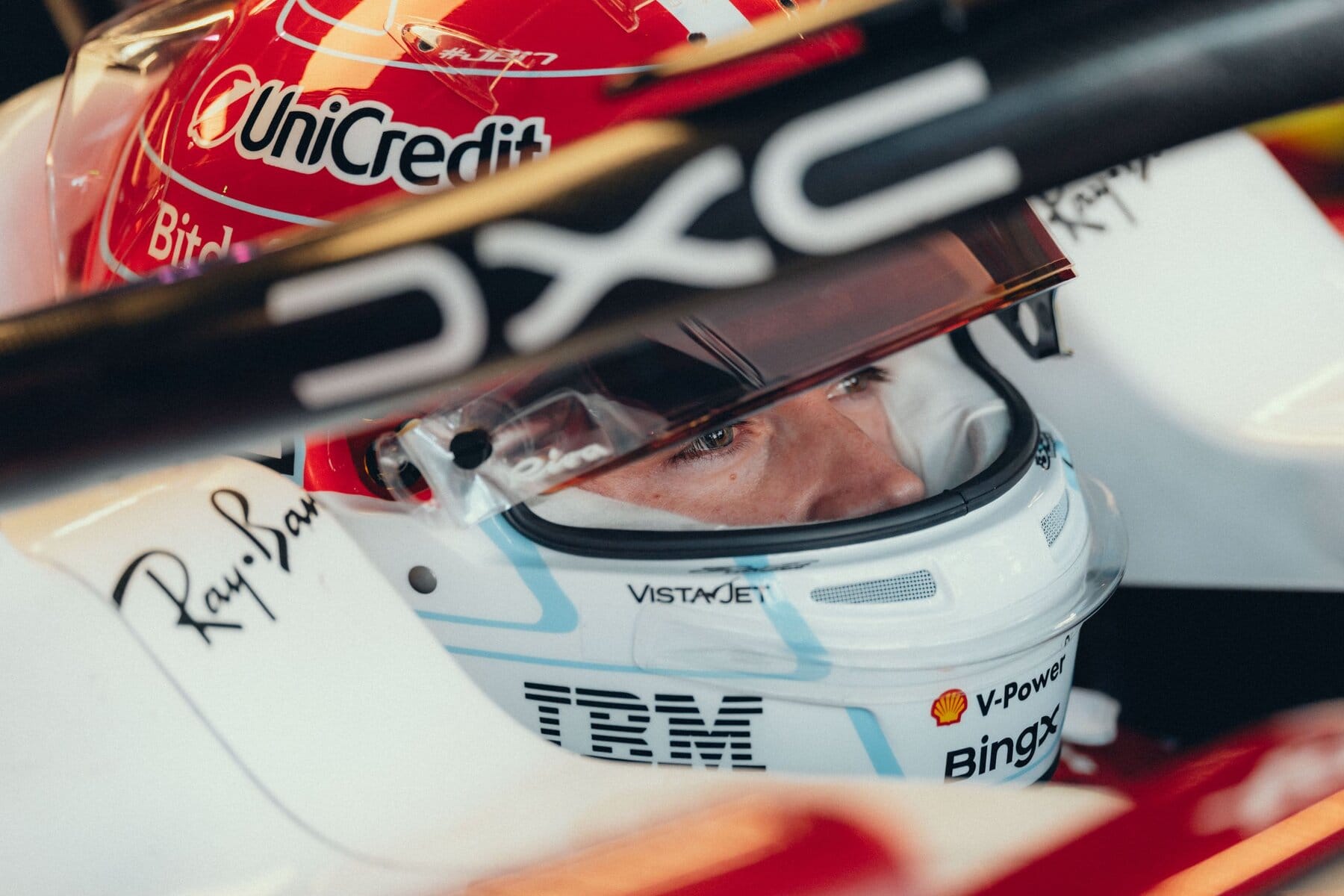
Ollie Bearman’s high-speed shunt at the Spoon Curve during the Japanese Grand Prix has poured further fuel on the already fiery debate surrounding the 2026 Formula 1 power-unit regulations, after the FIA acknowledged that “high closing speeds” contributed to the incident.
The Haas driver endured a brutal 50G impact with the barriers on Lap 22, following an estimated 35 km/h speed differential between himself and Alpine’s Franco Colapinto on the approach to the left-hander.
Even on the broadcast, the disparity in speed was evident—forcing Bearman to jink to the left of the circuit as Colapinto drifted across, seemingly unaware of the Haas’ rapid approach.
Bearman ran onto the grass before his VF-26 spun into the barriers backwards, after which he was seen limping away to safety. A subsequent visit to the medical centre confirmed he had fortunately sustained nothing more than a contusion to his right knee.
Formula 1’s governing body, the FIA, released a statement following the race acknowledging the incident, while cautioning against any premature or knee-jerk reaction.
“Following the accident involving Oliver Bearman at the Japanese Grand Prix and the contribution of high closing speeds, the FIA would like to provide the following clarifications,” the statement read.
“A number of meetings are therefore scheduled in April to assess the operation of the new regulations and to determine whether any refinements are required,” it added.
“Any potential adjustments, particularly those related to energy management, require careful simulation and detailed analysis.”
The governing body further explained that discussions between the FIA, Formula 1, teams, manufacturers, and drivers will continue before any decisions are made.
“The FIA will continue to work in close and constructive collaboration with all stakeholders to ensure the best possible outcome for the sport, and safety will always remain a core element of its mission.
“At this stage, any speculation regarding the nature of potential changes would be premature.”
However, that did not prevent a vociferous response from drivers, including GPDA Director Carlos Sainz, when questioned post-race.
“That’s the problem when you listen only to the teams—they might think the racing is fine because they’re enjoying it on TV,” the Spaniard said, despite not having seen a replay of the incident.
“But from a driver’s standpoint, when you’re racing and realise there can be a 50 km/h speed delta, that’s not really racing.
“There’s no category in the world where you have these kinds of closing speeds. That’s when major accidents can happen—because it catches you by surprise. You defend late, and it’s already too late for you or the car behind.
“Anyway, I really hope they listen to us and focus on the feedback we’ve given, rather than only listening to the teams.
“I hope they come up with a plan for Miami that improves the situation, and also a plan for the medium-term future of these regulations.
“Even if you can’t fix everything for Miami, take a good step there—and then a bigger one later in the season, or next year.”
Sainz also highlighted the potential danger of a similar incident occurring at circuits such as Baku or Singapore, where high speeds are combined with unforgiving concrete walls.
Concerns about such scenarios had already been raised ahead of the 2026 season by several key figures, including McLaren team principal Andrea Stella, who warned that disparities in energy deployment—between drivers pushing flat-out and those harvesting or experiencing “super clipping”—could create chaotic and dangerous situations.
With even the FIA acknowledging the safety implications—long a core pillar of its mission, particularly since the tragic events of 1994, when Ayrton Senna and Roland Ratzenberger lost their lives at Imola—this is clearly an issue requiring serious attention.
Regardless of whether the racing is deemed entertaining. That, too, has been a point of contention, with repeated criticism from drivers such as Max Verstappen, who has likened the current product to Mario Kart rather than genuine racing.
The intended goals of the 2026 regulations are commendable: smaller chassis have improved raceability compared to both the ground-effect era and its predecessor, while the 50/50 power-unit split holds potential to enhance the spectacle. However, in its current form, the package is in urgent need of refinement—particularly on safety grounds.
Want more F1Chronicle.com coverage? Add us as a preferred source on Google to your favourites list for the best F1 news and analysis on the internet.
From F1 news to tech, history to opinions, F1 Chronicle has a free Substack. To deliver the stories you want straight to your inbox, click here.
For more F1 news and videos, follow us on Microsoft Start.
New to Formula 1? Check out our Glossary of F1 Terms, and our Beginners Guide to Formula 1 to fast-track your F1 knowledge.

Comments
More in News

Mario Kart in Real Life: Why the 2026 Japanese GP Crash is F1’s Ultimate Warning Sign
‘It’s just not what I want to do’, Max Verstappen admits there is a lot for him to figure out as F1 future decision looms
Kimi Antonelli: ‘It’s too early to think about the championship’
Oscar Piastri: ‘We did everything right and still got beaten by 15 seconds’