
F1 Strategy at Suzuka: Tyres, Pit Stops and Overtaking
Race strategy at Suzuka revolves around a problem that no other circuit presents in quite the same way. The fast, flowing corners that make the track so rewarding to drive also place extreme and sustained loads on the tyres, and the limited overtaking opportunities mean that track position carries more weight here than at almost any other venue on the calendar.
Getting the pit stop timing wrong at Suzuka does not just cost a few seconds. It can cost multiple positions that are very difficult to recover on a circuit where passing another car requires either a clear pace advantage or a perfectly timed move into one of the few braking zones where side-by-side racing is possible.
Why Suzuka Is One of the Hardest Circuits for Tyre Management
What Makes the Surface So Demanding
The combination of high-speed corners, sustained lateral loads, and an abrasive track surface makes Suzuka one of the most punishing circuits for tyres in Formula 1. The S Curves in the first sector subject the tyres to rapid directional changes at speeds above 200km/h, generating significant energy through the rubber with each transition. Spoon Curve in the third sector keeps the car under lateral load for an extended duration, which heats the outside shoulder of the tyre more aggressively than a shorter corner taken at similar speed. The 130R corner adds another peak load event where the tyre must deliver maximum lateral grip at approximately 300km/h.
The cumulative effect of these demands across a full stint means that Suzuka generates some of the highest tyre energy loads of any circuit on the calendar. As former Pirelli Motorsport Director Mario Isola has noted, the circuit is “as demanding on tyres as it is on drivers,” with the sustained energy loads through the corners ranking among the highest Pirelli records across the entire season. This is why Pirelli consistently brings the three hardest compounds in their range to the Japanese Grand Prix: the surface and the layout require compounds that can withstand sustained thermal and mechanical stress without degrading to the point where lap time drops significantly before the pit window opens.
Compound Selection and How It Shapes the Race
The selection of the C1, C2, and C3 compounds for Suzuka, the hardest trio in the Pirelli range, tells teams that the tyre supplier expects high degradation and significant wear across a race distance. The C1 hard compound is the foundation of most Suzuka strategies because it offers the longest stint length and the most consistent performance through the lap’s demanding corners. The C2 medium is typically the preferred starting tyre for cars in the top ten, offering a better balance between initial pace and degradation than the C1 while lasting long enough to reach the first pit window without excessive drop-off.
The C3 soft compound at Suzuka is a qualifying tyre more than a race tyre. Its peak grip is useful for a fast lap in Q3, but the thermal demands of the circuit cause the soft to overheat and lose performance within a relatively short number of laps under race conditions. Teams occasionally use the soft for a short final stint when track position is already secured, but starting on the soft and trying to make it last to a reasonable pit window is a strategy that rarely pays off at this circuit. The hard surface and the energy generated through the fast corners simply consume the softer rubber faster than at venues with lower lateral loads.
Pit Stop Strategy at Suzuka
One Stop vs Two Stop
The optimal pit stop strategy at Suzuka depends on the specific conditions of the race weekend, but both one-stop and two-stop approaches have proven competitive in recent years. The track was resurfaced in the first sector ahead of the 2025 race, which reduced the abrasiveness of the asphalt through the S Curves and lowered the overall degradation rate. That change, combined with cooler spring temperatures for the 2026 race date, may shift the strategic balance further toward a one-stop approach than was typical during the autumn events of previous seasons.
A one-stop strategy at Suzuka typically runs medium tyres for the first stint, targeting a pit window somewhere between laps 19 and 26, before switching to the hard compound for the run to the flag. The reverse, starting on hards and switching to mediums, opens a later pit window and gives the driver fresher tyres for the closing laps, which can be an advantage if the cars ahead are managing worn rubber in the final stint. The two-stop alternative splits the race into three shorter stints, usually soft-medium-hard or medium-hard-medium, and trades track position for fresher rubber in the final phase of the race. The risk of a two-stop at Suzuka is that the time lost in the pit lane, combined with the difficulty of overtaking on track, can leave the driver stuck behind slower cars on better strategy even if their raw pace is faster.
The Undercut and Why Track Position Matters So Much
The undercut at Suzuka, where a team pits their driver before the car ahead to gain track position through the speed advantage of fresh tyres, is one of the most powerful strategic tools on the calendar specifically because overtaking on track is so difficult. A driver who emerges from the pit lane ahead of a rival who has not yet stopped can often defend that position through the technical sections of the circuit even if the rival has a pace advantage, because the fast, flowing corners make it nearly impossible to follow closely enough to attempt a pass.
This dynamic means that the timing of the first pit stop is often the most consequential strategic decision of the race. Teams monitor the tyre performance data in real time through the telemetry systems built into the 2026 car and make their pit call based on whether the undercut window is open, whether the car ahead is showing signs of degradation, and whether the pit lane gap is small enough to make the undercut work. Getting the call right by even one or two laps can be the difference between finishing on the podium and finishing in the middle of the field.
Overtaking at Suzuka in the 2026 Era
Where Passes Happen
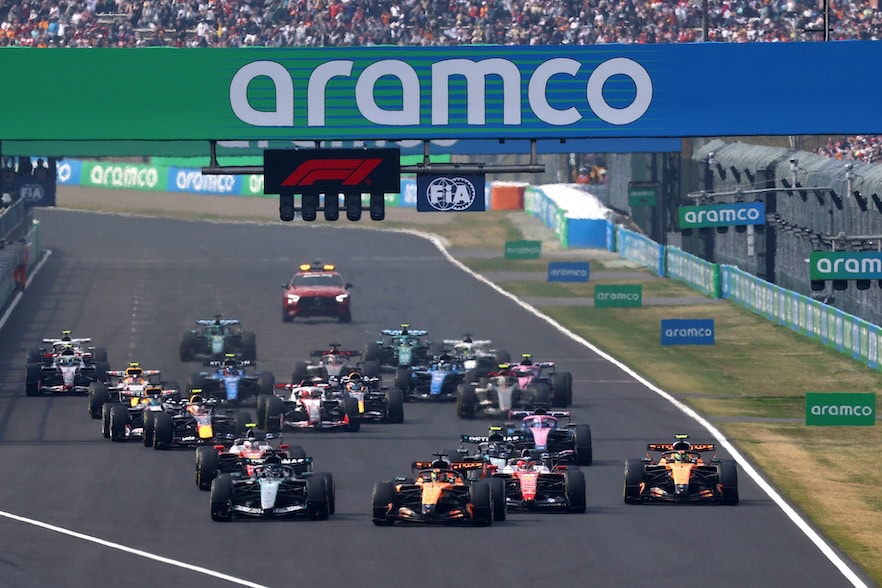
Suzuka has two realistic overtaking zones under racing conditions. The primary opportunity is the chicane at the end of the lap, where the long approach from 130R at over 250km/h creates a heavy braking zone into the tight left-right-left sequence. A driver who can carry more speed down the approach, either through slipstream or the overtake override, and then brake later into the first element of the chicane can force the defending car to concede the inside line. The second opportunity is Turn 1 at the start of the lap, where the run from the start-finish straight provides enough braking distance for a car with a speed advantage to pull alongside before the corner.
Beyond these two points, overtaking at Suzuka is rare. The S Curves, Degner section, and Spoon Curve all require the car to be on the optimal racing line to carry speed, and a car that moves offline to attempt a pass through these sections loses aerodynamic performance and tyre temperature, making it very difficult to complete the move. This is why strategic overtaking through pit stop timing is often more effective at Suzuka than on-track passing, and why teams invest significant effort in optimizing their pit window relative to their direct competitors rather than relying on the driver to make positions on track.
The Overtake Override and How It Changes the Picture
The 2026 regulations replace the DRS system of previous eras with a proximity-based overtake override that gives the following car additional MGU-K power when within one second of the car ahead in a designated activation zone. At Suzuka, this system applies on the approach to the chicane, where the following driver can deploy the full 350kW MGU-K output up to 337km/h rather than the standard rampdown that begins at 290km/h.
The effect is an increase in straight-line speed approaching the braking zone, which provides a similar speed differential to what the old system offered but through electrical power rather than reduced drag. The defending driver does not receive the additional deployment, creating an asymmetry that makes the braking zone into the chicane a genuine overtaking opportunity for the following car. The energy cost of each activation is 0.5MJ, which means repeated use across a race distance has cumulative implications for the overall energy budget. A driver who uses the override aggressively in the opening laps may arrive at the closing laps with less stored energy available for deployment, creating a strategic trade-off between attacking for position now and preserving energy for later.
At Suzuka, where the limited overtaking opportunities make every passing attempt valuable, the decision of when to use the override and when to save the energy is a judgment call that falls to the driver in the moment. The complete Suzuka guide covers the broader circuit picture, including the corner-by-corner breakdown that explains why overtaking is confined to so few points on this uniquely demanding layout.
Suzuka Strategy FAQs
Why Is Suzuka So Hard to Overtake?
Suzuka is so hard to overtake because the majority of the circuit consists of fast, flowing corners where the car following closely behind loses aerodynamic performance in the disturbed air of the car ahead. The S Curves, Degner section, Spoon Curve, and 130R all require the car to be on the optimal racing line to carry speed, and any deviation from that line to attempt a pass costs more time than it gains. A driver who pulls alongside through the Esses or Spoon immediately compromises their own cornering speed, which means even if they draw level for a moment, the car on the racing line pulls away by the next corner.
The circuit has only two realistic braking zones heavy enough to allow a car to lunge alongside and complete a pass: the chicane at the end of the lap and Turn 1 at the start. The rest of the 5.807-kilometer lap is flowing sequence where track position is defended by the layout itself rather than by the driver. This is why pit stop strategy, the undercut, and the timing of tyre changes carry more strategic weight at Suzuka than at circuits with multiple long straights and heavy braking zones.
Is Suzuka Low or High Downforce?
Suzuka is a high downforce circuit. The number of fast, sustained corners on the lap, including the S Curves, Spoon Curve, and 130R, means teams need maximum aerodynamic grip to carry speed through the sections that define lap time. Running a low downforce setup at Suzuka gains a small amount of straight-line speed on the relatively short straights but loses far more time through the corners, where the car spends the majority of the lap.
The setup compromise at Suzuka is not between high and low downforce but between how much downforce to run and where to distribute it across the car. The balance between front and rear aerodynamic load determines how the car handles through the direction changes of the S Curves, whether it understeers or oversteers through Spoon, and how stable it feels at peak speed through 130R. In the 2026 era, the active aerodynamic system adds flexibility by allowing the wings to switch between X-mode on the straights and Z-mode through the corners, but the base aerodynamic configuration still needs to be optimized for the high-downforce demands of the circuit.
Where Do Most Overtakes Happen at Suzuka?
Most overtakes at Suzuka happen at the chicane at the end of the lap, where cars brake from over 250km/h after the 130R corner into a tight left-right-left sequence. The long braking zone gives the following car time to pull alongside under braking, and the tight first element of the chicane rewards the driver who commits to the inside line. The 2026 overtake override system, which provides the following car with additional MGU-K power in the activation zone, makes this braking zone even more effective as a passing point than it was under the previous regulations.
Turn 1 is the only other consistent overtaking point, primarily on the opening lap and at restarts when cars are running in close proximity. Beyond these two locations, overtaking on track is extremely rare. Most position changes at Suzuka happen through pit stop strategy rather than wheel-to-wheel racing, which is why the undercut is such a powerful tool at this circuit and why the timing of the first pit stop often determines the final result more than raw pace alone.
Why Do F1 Drivers Love Suzuka?
F1 drivers love Suzuka because the circuit rewards driving skill more than almost any other track on the calendar. The fast, flowing corners demand commitment, precision, and confidence from the first lap to the last, and the figure-eight layout with its near-equal split of left and right turns tests every aspect of a driver’s ability. There are no slow processional sections where a driver can rest. The entire lap requires full concentration, and the satisfaction of linking a perfect sequence through the S Curves, Degner, Spoon, and 130R is something drivers consistently describe as one of the best feelings in the sport.
The circuit also punishes mistakes in a way that modern run-off areas at other venues do not. Gravel traps and barriers are close to the track at several points, which means an error at Suzuka has real consequences rather than a harmless trip across tarmac. That risk-reward dynamic is part of what makes a clean, fast lap at Suzuka so rewarding, and it is the reason drivers have ranked it as their favorite circuit in surveys and interviews for decades. The combination of technical difficulty, high-speed commitment, and a layout that has barely changed since 1962 gives Suzuka a character that no other circuit on the calendar matches.
Sources
Pirelli Motorsport: To Suzuka for Something New and Something Old
BBC Sport: Japanese Grand Prix Coverage
FIA: 2026 Formula 1 Technical Regulations

Comments
More in News
2026 F1 winners and losers; who stands where during this enforced lull?
Niki Lauda Before the Crash: The Driver, the Fire, and the Greatest Comeback in F1
‘Grateful that they made the decision for me’, Daniel Ricciardo reflects on F1 axing

Alpine highlight “equal opportunity for both drivers to be competitive,” in open letter addressing online abuse
