
The Enduring Magic of Monte Carlo: Why the Monaco Grand Prix Reigns Supreme
The Monaco Grand Prix reigns supreme because no other race on the Formula 1 calendar carries the same weight of history, drama, and sheer visual spectacle. The internet’s loudest voices will tell you Monaco should be dropped from the calendar: the cars are too big, the overtaking is nonexistent, the race is a procession. And every single year, a quarter of a million people pack themselves into a 2km strip of Mediterranean coastline to prove them wrong.
The race has survived every era of Formula 1, from the front-engined cars of the 1950s to the ground-effect machines of the 2020s and now the active-aero cars of 2026. It predates the World Championship itself: the first Monaco Grand Prix was held in 1929, two decades before F1 existed. In September 2025, F1 CEO Stefano Domenicali announced that the race has been secured until at least 2035, calling it “an iconic race that is loved by all drivers and fans, with a unique vibe thanks to its location on the world’s most glamorous Principality.” When the sport’s own chief executive talks like that about a race venue, the people writing “drop Monaco” threads from their sofas are fighting a losing battle.
No Other Race Produces Stories Like This
Ask anyone who loves Monaco to defend it and they will skip the statistics entirely. They will tell you about the moments that made them feel something.
In 1955, Alberto Ascari missed the chicane at the harbour, crashed through the straw bales and sandbags, and sent his Lancia straight into the water. He surfaced with nothing worse than a cut on his nose and was pulled out by divers. It would be his final Grand Prix. Four days later, Ascari was killed testing at Monza. That single image of a Formula 1 car bobbing in the Monaco harbour became one of the most reproduced photographs in motorsport history.
In 1984, a 24-year-old Ayrton Senna drove a Toleman through monsoon conditions, starting 13th and catching race leader Alain Prost’s McLaren before the race was controversially red-flagged. It was the drive that announced Senna to the world. Four years later, on the same streets, Senna produced what is widely considered the greatest qualifying lap in the sport’s history. He put his McLaren 1.427 seconds ahead of teammate Prost in identical machinery. “I suddenly realised that I was no longer driving conscious,” Senna said afterwards. “I was in a different dimension.” He went on to win six Monaco Grands Prix, five of them consecutive between 1989 and 1993. That record still stands.
In 1992, Nigel Mansell had the dominant Williams car and was cruising to victory until a loose wheel nut forced him into the pits. He emerged behind Senna on fresh tyres, set lap records, and spent the final four laps glued to the Brazilian’s gearbox. He finished 0.215 seconds behind. The two greatest drivers of that generation, at the peak of their ability, separated by the width of a crash barrier for four laps around the streets of Monte Carlo. No amount of DRS zones could manufacture that kind of tension.
In 1996, Olivier Panis started 14th in a Ligier, a team that had not won a race in 15 years. Rain arrived on race day and car after car fell victim to the conditions. Panis timed his switch to dry tyres perfectly and took the lead, then held off David Coulthard to the flag for his first and only Formula 1 victory. It was also Ligier’s last-ever race win. That is the kind of story that can only happen at Monaco, where the margins between glory and the barriers are measured in centimetres.
In 2016, Daniel Ricciardo qualified on pole, led the race comfortably, and pitted for new tyres only to find Red Bull did not have them ready. The delay handed victory to Lewis Hamilton. “It haunted me for two years,” Ricciardo said. “It was just pure rage.” He returned to win at Monaco in 2018, channelling that anger into the most satisfying victory of his career.
And in 2024, Charles Leclerc finally broke what had become known as the Monaco curse. The Monegasque driver, racing on the streets where he grew up, had suffered a DNS from pole in 2021 after a gearbox failure and a devastating strategy error that dropped him from the lead to fourth in 2022. When he crossed the line in first, he became the first Monaco-born driver to win his home Grand Prix in 93 years. “I was thinking about my dad a lot more than I thought while driving,” Leclerc said. “He gave everything for me to be here, and it was a dream of ours for me to race here and to win.”
Every one of those stories gets told and retold whenever someone new falls in love with the sport. Monaco wrote most of F1’s best chapters.
The Hardest Day’s Work In Formula 1
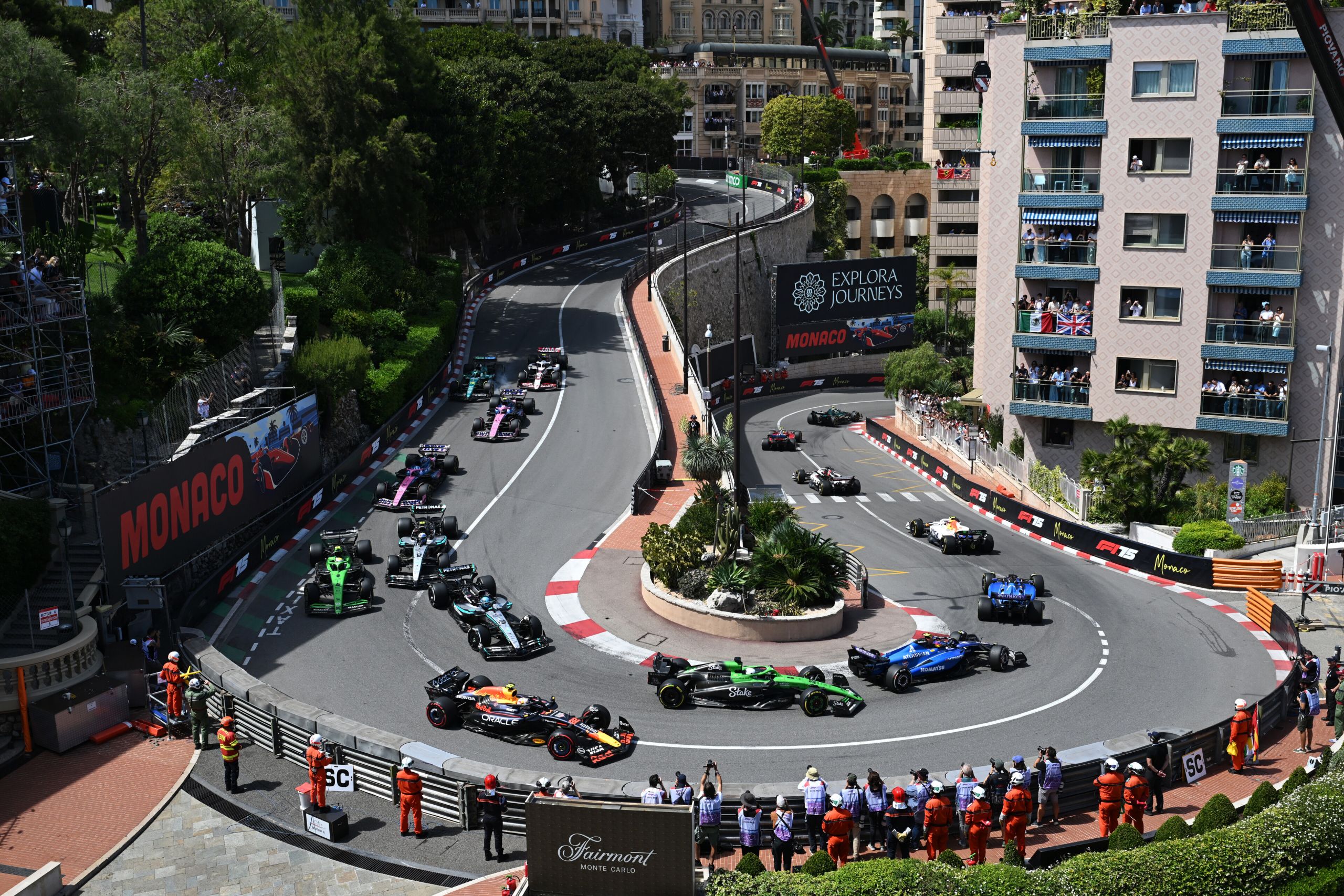
The overtaking debate dominates the online conversation about Monaco, and it misses what makes the race special. At every other circuit on the calendar, qualifying sets the grid and the race reshuffles it. At Monaco, qualifying IS the event. Saturday afternoon around the Circuit de Monaco is the purest expression of one-lap speed in Formula 1, with drivers pushing to within millimetres of concrete walls at 260 km/h knowing that a single lock-up will end their weekend.
Nelson Piquet called it “like riding a bicycle around your living room.” That analogy has been quoted for 40 years because it is perfect. The track is 3.337km of armco barriers, tunnel exits, elevation changes, and camber shifts that make most modern circuits look like car parks. The Fairmont Hairpin is taken at 45 to 48 km/h, the slowest point on the entire F1 calendar. Through the Swimming Pool section, cars thread between the walls at over 200 km/h with less than a metre of runoff on either side. There is nowhere else in motorsport where the consequence of a mistake is so immediate.
That is what the “boring race” crowd refuses to acknowledge. Every other circuit gives drivers runoff, gravel traps, and second chances. Monaco offers armco. The race might not produce 50 overtakes, but it produces 78 laps of a concentration test that grinds drivers down like no other event on the calendar.
The Race Every Fan Wants To See In Person
Beyond the on-track argument, there is a simpler truth: people want to be there. The 2025 race drew 250,000 spectators across the four-day weekend, up from 200,000 when the Automobile Club de Monaco last published official figures in 2017. Grandstand tickets for race day start at roughly £900 and sell out within weeks of going on sale. The hospitality packages on the yachts in the harbour run into the tens of thousands. And people pay it, every year, because there is no other sporting event on earth that looks or feels like the Monaco Grand Prix.
The backdrop alone makes the case. Formula 1 cars racing past the Casino de Monte-Carlo, diving through the tunnel, emerging into harbour light with superyachts stacked three deep along the waterfront. The Swimming Pool section runs between the Mediterranean and a row of apartment buildings where spectators watch from balconies. The podium sits in the shadow of the Prince’s Palace. No architect could design a more photogenic venue for a motor race, and no amount of purpose-built facilities can replicate what a century of history has created in the Principality.
For the sport’s commercial health, that visibility cannot be replaced. Monaco is the race that appears on travel bucket lists and in Hollywood films. It is the race that non-F1 fans have heard of. When Formula 1 pitches to new audiences in the United States, Latin America, or Asia, Monaco is the image that sells the product. Drop it, and you remove the single most recognisable visual in motorsport.

What The Critics Get Wrong
The argument against Monaco rests on a single metric: on-track overtakes. And by that measure, Monaco has been poor for decades. The 2003 race produced zero passes for position across the entire Grand Prix distance. Several recent races have been labelled processions. If your only measure of a good Grand Prix is the number of times one car moves past another, Monaco fails the test.
But that is a narrow way to watch racing. Not every Grand Prix needs 50 overtakes to justify its existence. The calendar already has Spa, China, and Bahrain for wheel-to-wheel battles. Monaco offers something different: it puts the driver, not the car, at centre stage. It forces strategy decisions made on the pit wall because passing on track is nearly impossible. It delivers races where a single safety car reshuffles the entire order, as it did when Perez crashed on the opening lap in 2024. And it creates the constant tension of knowing that every corner is a potential championship-altering mistake.
Fernando Alonso, a two-time Monaco winner, was asked whether the race should be dropped for its lack of overtaking. He called the idea “absurd.” Charles Leclerc put it more simply: “F1 without Monaco for me is not F1.”
Monaco In The New Era
The 2026 Monaco Grand Prix is the first real test of whether new regulations can address the overtaking criticism without destroying what makes the race what it is. The cars are lighter and smaller than the ground-effect machines that drew so much frustration from 2022 to 2025. The active aerodynamic system that replaced DRS has been modified for Monaco: Straight Mode has been dropped entirely because the circuit’s straights are too short for the mandatory three-second activation zone. Overtake Mode, which provides an electrical power boost to a chasing car, remains available.
Whether this produces better racing is unknown. But that uncertainty has always been part of Monaco’s appeal. The circuit has reinvented itself before, adding the Swimming Pool section in 1973, replacing the chicane in 1986, and renegotiating its commercial terms to compete with Middle Eastern venues that offer far larger hosting fees. It has held its place on the calendar for 71 consecutive years by being something no other race can be: unmistakable, unrepeatable, and irreplaceable.
The internet will debate whether Monaco belongs again this weekend. The 250,000 people in the grandstands, on the yachts, and on the apartment balconies will not care. They will be watching Formula 1 cars race through the same streets where Fangio raced in 1950 and Senna drove in another dimension in 1988, and they will understand what the spreadsheet critics never will: some things in sport are bigger than data…
Want more F1Chronicle.com coverage? Add us as a preferred source on Google to your favourites list for the best F1 news and analysis on the internet.
For more F1 news and videos, follow us on Microsoft Start.
New to Formula 1? Check out our Glossary of F1 Terms, and our Beginners Guide to Formula 1 to fast-track your F1 knowledge.
Read this article in: Português
More F1 Reading
- How Many Championships Did Alain Prost Win?
- Rewind To The 2018 Italian Grand Prix: A Hamilton Vs Raikkonen Classic Duel
- Who Was the Last Driver Chosen By Enzo Ferrari?
- How Many F1 Drivers Are From Mexico?

Comments
More in News

Lewis Hamilton Tells Ferrari Critics to ‘Point Fingers Somewhere Else’ as He and Charles Leclerc Back Fred Vasseur
Lando Norris Admits He Got Caught Up in ‘the Heat of the Moment’ After Apologising to Franco Colapinto Over Baku Comments

George Russell Declares He Is No Longer ‘Lost’ in His Mercedes as He Puts the Title Pressure Squarely on Kimi Antonelli

Sepang Track Guide: A Corner-By-Corner Breakdown
