
Antonelli Wins Third Straight as Penalties Hit Leclerc and Verstappen
- Kimi Antonelli won the 2026 Miami Grand Prix from pole position for his third consecutive victory, beating Lando Norris by 3.2 seconds after Mercedes executed a perfectly timed undercut.
- Charles Leclerc spun on the final lap, hit the wall, and then received a 20-second post-race penalty for repeatedly leaving the track, dropping him from sixth to eighth in the classification.
- Max Verstappen recovered from a first-lap spin that dropped him to ninth, using an early pit stop under the Safety Car to climb back to fifth, though a five-second penalty for a pit exit breach was added to his race time.
How Kimi Antonelli Won the 2026 Miami Grand Prix
The 2026 Miami Grand Prix delivered a race full of drama, strategy calls, and post-race controversy as Kimi Antonelli claimed his third consecutive Formula 1 victory, this time at the Miami International Autodrome. The 19-year-old Mercedes driver started from pole position and crossed the line 3.2 seconds ahead of McLaren’s Lando Norris, with Oscar Piastri completing the podium in third. The result extended Antonelli’s championship lead to 100 points, 24 clear of his teammate George Russell on 76.
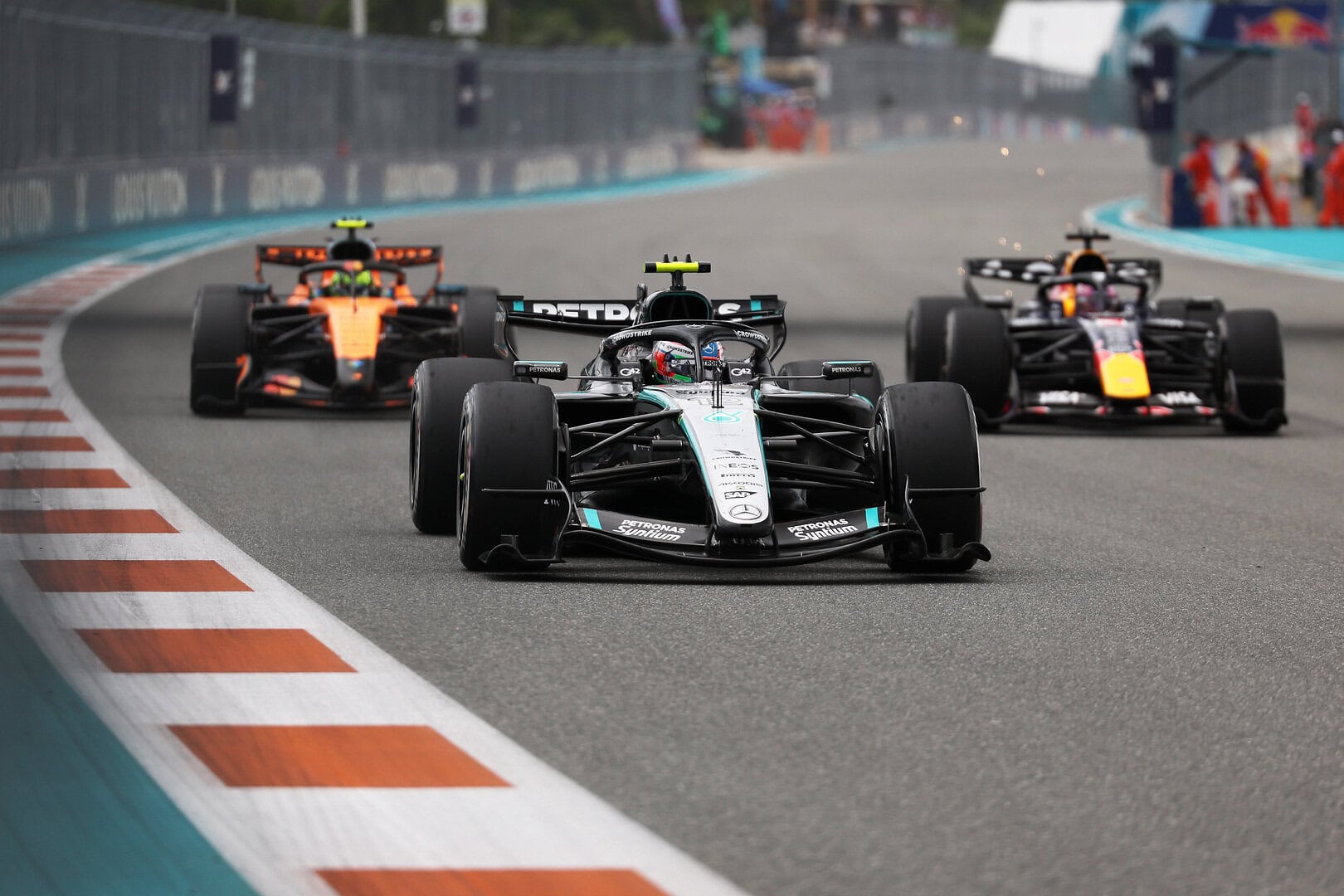
Antonelli’s start was not clean. He locked up into Turn 1, allowing Charles Leclerc to briefly take the lead through the opening corners. He then lost another position to Norris before the Safety Car was deployed. But Mercedes outfoxed McLaren on strategy, timing Antonelli’s pit stop to execute an undercut that proved decisive. He emerged from the pits just behind Norris, and with his Hard tyres already up to working temperature, he passed the McLaren and controlled the race from there to the finish.
Speaking after the race, Antonelli reflected on a victory that required patience and a team effort to pull off.
“That was not an easy race at all but I’m so happy we were able to bring the victory home. My start wasn’t as bad as in the Sprint, but we still lost a position. I then lost a place to Lando (Norris) before the Safety Car, but we were able to fight back. Our pace was strong, I was able to stay close, and then the team did a brilliant job with the strategy. The undercut worked out just about perfectly and, despite the McLaren coming out just ahead, we were able to get past with our tyres being up to temperature. Despite our great start to the season, we are not getting ahead of ourselves. This is just the beginning of the season and there is a long year ahead. We are working super hard and the team is doing an incredible job at the moment. Without all the men and women at Brackley and Brixworth we wouldn’t be in this position. We’re going to continue to work hard, bring performance to the track, and aim for another good weekend in Canada.”
A Chaotic Start and Early Safety Car
Organisers brought the race start forward by three hours to 13:00 local time due to forecasts of heavy thunderstorms later in the afternoon. The 57-lap contest went ahead under dry conditions, but the opening laps were anything but calm.
Max Verstappen started from the front row alongside Antonelli but fared worst of all at the start. The Red Bull driver spun through a full 360 degrees after early contact and dropped from second to ninth. The field had barely settled before incidents involving Isack Hadjar and Pierre Gasly brought out the Safety Car on lap six, the first major turning point of the afternoon.
Strategy and Tyre Management
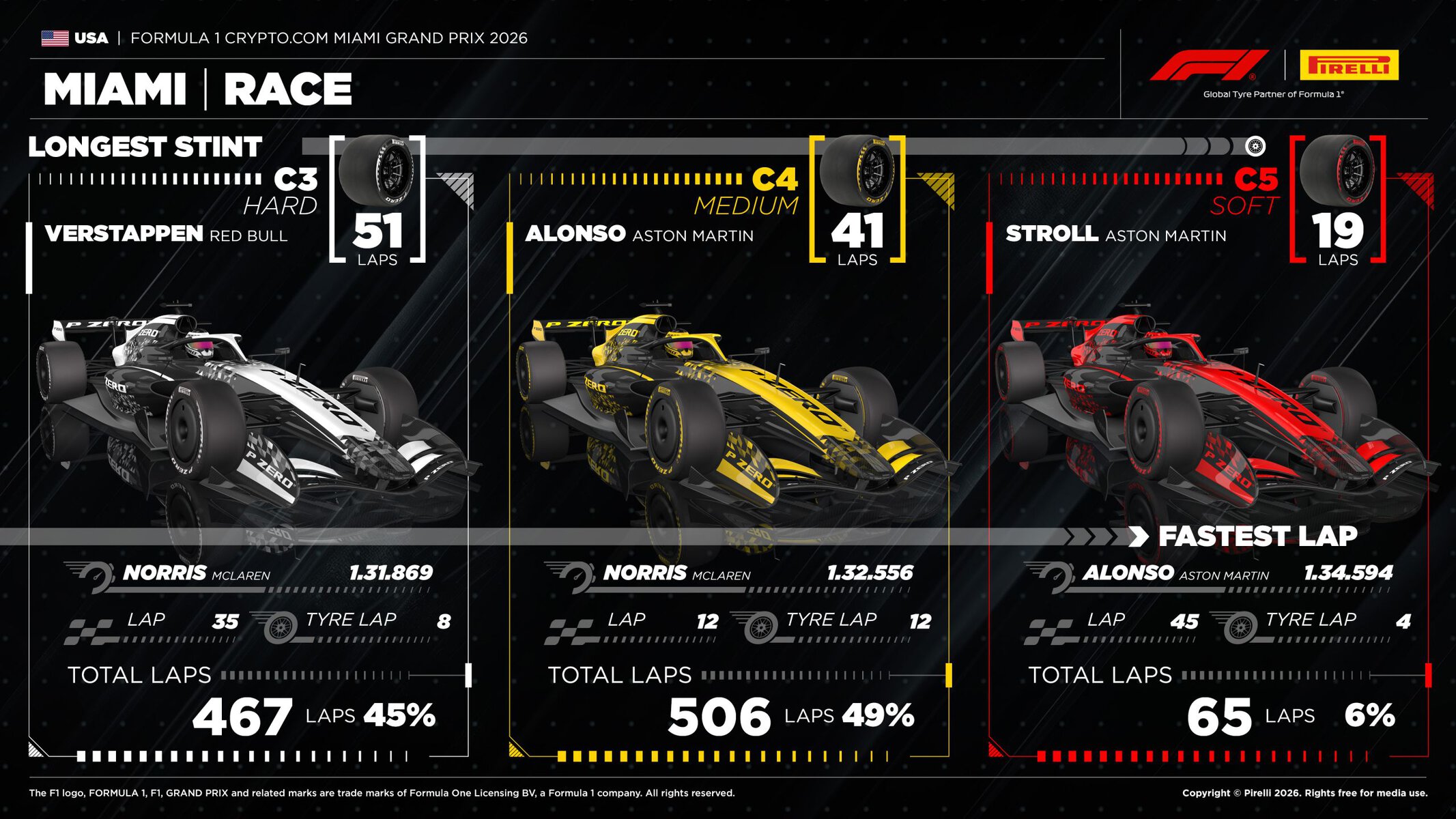
The Safety Car period opened a strategic window that several teams exploited. Verstappen and Valtteri Bottas both pitted during the neutralisation. Verstappen switched from his starting set of Medium tyres to Hards on lap six, committing to a long second stint that would ultimately last 51 laps without any need to manage his pace. Bottas took the opposite approach and fitted Softs, before stopping again on lap 21 for Mediums in a two-stop strategy.
Hadjar was the only driver to start from the pit lane on Hard tyres. The rest of the grid lined up on Mediums. When the field made their single pit stops, the majority followed Verstappen’s lead and moved onto Hards. Only the two Aston Martin drivers mirrored the Bottas approach by taking Softs at the tyre change. Strategies were almost exclusively one-stop, with Bottas, Fernando Alonso, and Lance Stroll the only drivers to make two visits to pit lane.
Pirelli Motorsport Director Dario Marrafuschi confirmed that the race played out largely within the expected strategic window, with the Safety Car the only significant variable.
“The race was very straightforward from a strategic point of view, despite the uncertainty over possible rain remaining right up to the last moment. The only real variable was the Safety Car on lap six, which allowed some drivers, including Verstappen, to pit early and differentiate themselves from the rest of the field. In the Dutchman’s case, this seems to have paid some dividends. Beyond that, all drivers on the grid opted for the flexibility of starting on the Medium, with the majority replacing it within the window we had anticipated. The lower temperatures compared to previous days further reduced tyre degradation. A clear example was Verstappen’s final stint of 51 laps on the Hard, completed without any need to manage the pace. The same trio of compounds will be used at the next round in Montreal in three weeks’ time.”
Leclerc’s Last-Lap Penalty: The Full Stewards’ Verdict
Charles Leclerc’s afternoon fell apart on the final lap. Running in sixth position, the Ferrari driver lost control at Turn 3 and spun into the wall. Though the car continued, the impact left it unable to take right-hand corners properly. Leclerc was forced to cut multiple chicanes on his way to the chequered flag, losing positions to both George Russell and Verstappen in the process. He crossed the line in sixth but the stewards were far from finished with his day.
The stewards called Leclerc before them for three separate potential offences: driving a damaged car in an unsafe condition, leaving the track multiple times and gaining an advantage, and contact with Russell at the final hairpin. After reviewing data, video, and radio evidence, the stewards imposed a drive-through penalty for leaving the track on several occasions without justifiable reason. Given that the penalty was issued after the race, it was converted into 20 seconds added to his race time. Leclerc dropped from sixth to eighth in the final classification.
The stewards’ full findings on the track limits offence read:
“Car 16 spun on the last lap at Turn 3 and hit the wall but continued on track. The driver informed us that the car appeared fine save that the car would not negotiate the righthand corners properly. Given this problem, he was forced to cut chicanes on the way to the chequered flag. We determined that the fact that he had to cut the chicanes (i.e. to leave the track) meant that he gained a lasting advantage by leaving the track in that manner. The fact that he had a mechanical issue of some sort did not amount to a justifiable reason. We accordingly impose a Drive Through penalty on Car 16, given the number of times the car left the track and gained an advantage. We also considered whether there was an additional breach in continuing to drive a car with an obvious and discernible mechanical issue. We determined that there was no evidence of there being an obvious of discernible mechanical issue. We therefore took no further action in relation to that potential infringement.”
In a separate investigation for Leclerc’s contact with Russell into Turn 17, the stewards deemed that no further action was necessary. Their decision stated: “Both drivers considered the contact to be minor racing incidents and we agreed.”
Verstappen’s Pit Exit Penalty: The Full Stewards’ Verdict
Verstappen also faced post-race scrutiny. When he rejoined the track after his early pit stop under the Safety Car, the front left tyre of his Red Bull crossed the white line separating the pit exit from the circuit. The stewards initially lacked clear video evidence to make an immediate decision during the race, so they deferred the investigation until afterwards. Additional camera angles confirmed the breach, and Verstappen received a standard five-second time penalty.
Under normal circumstances, the penalty would have dropped Verstappen from fifth to sixth behind Leclerc. However, Leclerc’s own 20-second penalty meant the Ferrari driver fell well behind in the adjusted classification, and Verstappen held onto fifth place.
The stewards’ full findings read:
“When the incident occurred, there was limited video evidence to make a clear decision on whether an infringement had occurred. We therefore decided to investigate the incident after the race, to see if we could get better video evidence of the incident in the meantime, perhaps from other angles. We were able to do so. The new angles did show more views of the pit exit line and the incident in question. The driver of Car 3 explained that he was driving out of the pit exit and rejoined the race under full course yellow. The stewards determined that the outside of the front left-hand tyre did cross the outside of the solid white pit exit line in violation of Appendix L, Chapter IV Article 6 c) of the International Sporting Code. Given the nature of the infraction, the stewards elected to impose a penalty of five seconds.”
Final Classification and Championship Standings
After both penalties were applied, the final top ten read: Kimi Antonelli, Lando Norris, Oscar Piastri, George Russell, Max Verstappen, Lewis Hamilton, Franco Colapinto, Charles Leclerc, Carlos Sainz, and Alexander Albon. Hamilton finished seventh after carrying damage from early-race contact. Colapinto delivered a strong result for Alpine, while Williams secured a double points finish through Sainz and Albon in ninth and tenth.
Nico Hulkenberg, Liam Lawson, Pierre Gasly, and Isack Hadjar were all classified as retirements.
In the Drivers’ Championship, Antonelli’s third win from three poles extended his lead to 100 points, 24 ahead of Russell on 76. The same trio of tyre compounds will be available when the championship moves to Montreal for the Canadian Grand Prix in three weeks.
Want more F1Chronicle.com coverage? Add us as a preferred source on Google to your favourites list for the best F1 news and analysis on the internet.
For more F1 news and videos, follow us on Microsoft Start.
New to Formula 1? Check out our Glossary of F1 Terms, and our Beginners Guide to Formula 1 to fast-track your F1 knowledge.
2026 Miami Grand Prix FAQs
Who won the 2026 Miami Grand Prix?
Kimi Antonelli won the 2026 Miami Grand Prix for Mercedes, finishing 3.2 seconds ahead of Lando Norris. It was his third consecutive Formula 1 victory after wins at the Chinese and Japanese Grands Prix earlier in the season.
Why was the 2026 Miami Grand Prix start time changed?
The race was brought forward by three hours, from a scheduled 16:00 start to 13:00 local time, due to forecasts of heavy thunderstorms in the Miami area during the original race window. The 57-lap race was completed in dry conditions.
What penalty did Charles Leclerc receive at the 2026 Miami Grand Prix?
Leclerc received a post-race drive-through penalty, converted into 20 seconds added to his race time, for leaving the track at the Miami International Autodrome on several occasions without justifiable reason after spinning on the final lap. The penalty dropped him from sixth to eighth in the classification.
What penalty did Max Verstappen receive at the 2026 Miami Grand Prix?
Verstappen received a five-second time penalty for crossing the white pit exit line when rejoining the circuit after his Safety Car pit stop. Despite the penalty, he remained classified fifth because Leclerc’s larger penalty kept the Ferrari behind him.
More F1 Reading
- ‘I Know It’s Very Close’: Kimi Antonelli Stays Focused as F1 Title Opportunity Looms
- Max Verstappen Says First Red Bull Engine Win Was Incredible After Hectic Bahrain Grand Prix Victory
- George Russell Admits His 2026 Title Hopes Are Now Exceptionally Unlikely After Cruel Bahrain GP Retirement
- Lewis Hamilton Reveals the Tyre Debate That Sank His Heart Before Remarkable Bahrain GP Recovery to Podium

Comments
More in News

‘I Know It’s Very Close’: Kimi Antonelli Stays Focused as F1 Title Opportunity Looms

Max Verstappen Says First Red Bull Engine Win Was Incredible After Hectic Bahrain Grand Prix Victory

George Russell Admits His 2026 Title Hopes Are Now Exceptionally Unlikely After Cruel Bahrain GP Retirement

Lewis Hamilton Reveals the Tyre Debate That Sank His Heart Before Remarkable Bahrain GP Recovery to Podium
