
Melbourne officially opens a Formula 1 season filled with more unknowns than ever. The cars, completely revised in terms of both power unit and aerodynamics, have already had their first taste of track action over nine days of testing between Barcelona and Sakhir. However, their true potential is likely to emerge only during the Australian Grand Prix weekend.
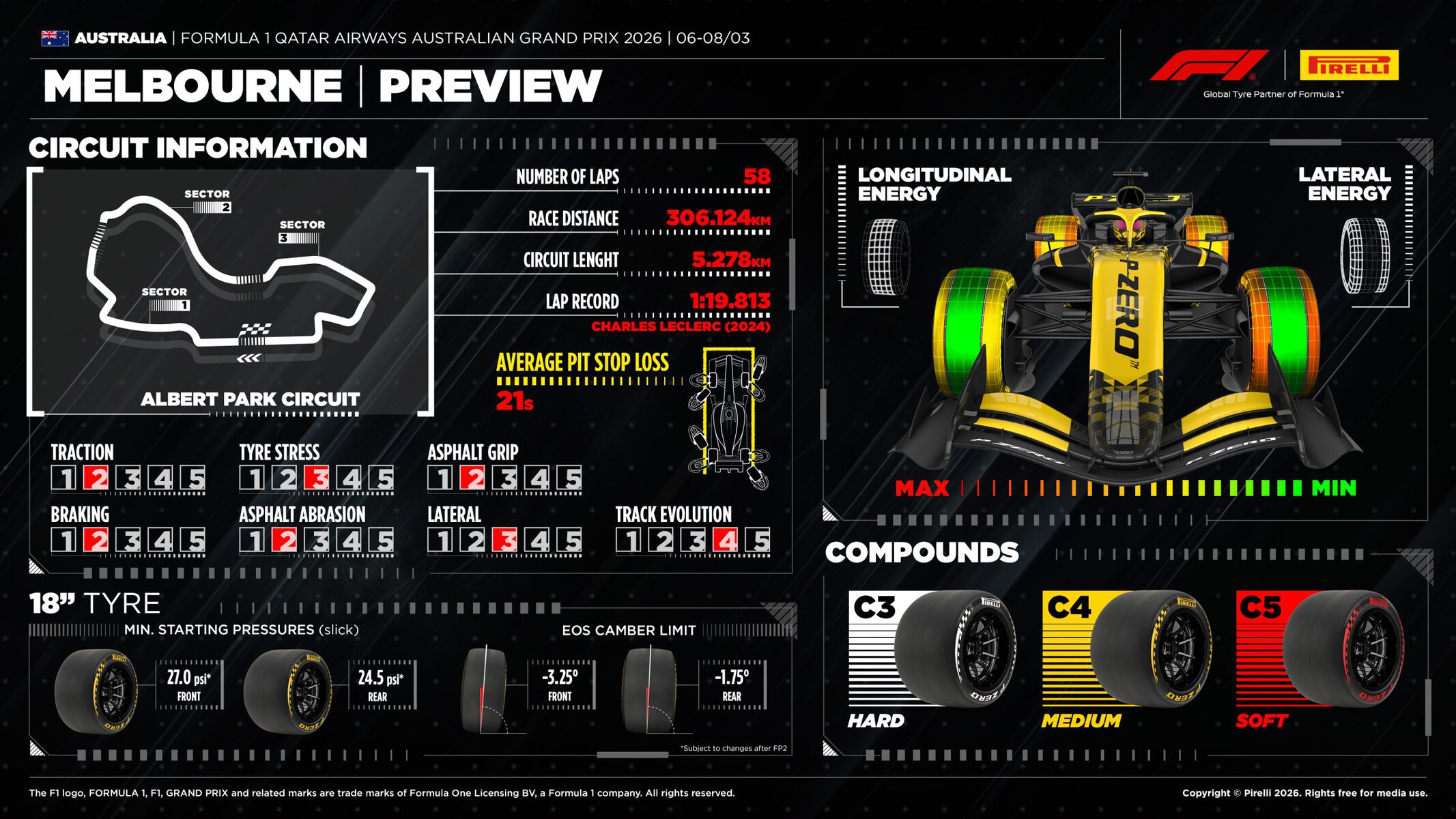
As with the cars, the tyres have also undergone changes. The tyres feature a reduced contact patch and overall diameter, while retaining the 18-inch wheel rim. There are five slick compounds, from C1 to C5, alongside the two wet-weather options: Intermediate and Full Wet.
For the Albert Park circuit, Pirelli has selected the three softest compounds in its range (C3, C4 and C5), as it did in the previous two seasons. The 5.278-kilometre street circuit runs around a lake and combines fast straights with low and medium-speed technical corners.
Its layout does not place particularly high demands on the tyres, with degradation typically driven more by wear than by thermal factors. The asphalt, made up in part of public roads normally open to traffic, is very smooth. Last year, on the days unaffected by rain, some graining appeared, albeit at very low levels.
From the very first free practice sessions, it will be interesting to see how teams choose to approach the weekend, the first event at which they can fully express the cars’ potential. An indication will certainly come from analysing how many performance runs and long runs are scheduled as early as Friday.
The initial track sessions will likely also help determine how best to balance temperatures across the two axles. The energy delivered by the power unit to the rear axle will inevitably accentuate an asymmetry that may need to be corrected, particularly in qualifying, either by differentiating tyre blanket temperatures or by completing a preparation lap before the flying lap.
When attempting to predict the number of pit stops that will shape race strategies, at least a couple of variables must be considered. The first concerns the loads generated by the individual cars, which could prove decisive in determining whether or not to use the softest compound during a race stint, theoretically an option on a relatively low-severity circuit such as Melbourne.
The second relates to overtaking opportunities. As we know, the cars are smaller than their predecessors, but despite modifications introduced in recent years, Albert Park remains a circuit where identifying the right section to attempt a move is not straightforward. The new Overtake mode could help in this respect.
Another variable factor over the Australian weekend could be the weather. The race takes place at the start of autumn (one week earlier than last year), a period characterised by frequent temperature swings and rainfall. Intermittent showers significantly affected the 2025 race, won by Lando Norris on Intermediates.
Australia By The Numbers
The Australian Grand Prix celebrates its 40th anniversary this year. The race will be held in Melbourne for the 29th time, the city having taken over from Adelaide in 1996, after the latter hosted the first eleven editions.
Michael Schumacher remains the most successful driver, with four victories — one more than Jenson Button and Sebastian Vettel. A further 21 drivers have won the event, including the reigning World Champion Lando Norris in 2025. The round in the southern hemisphere is one of the races with the greatest variety of winners.
Among the constructors, McLaren holds the record with 12 victories, just one more than Ferrari.
How to Watch the 2026 Australian Grand Prix
Formula 1 fans around the globe can catch all the action from the 2026 Australian Grand Prix through various broadcasters and streaming services.
In the United Kingdom, viewers can watch every session live on Sky Sports F1, with comprehensive coverage of the practice sessions, qualifying, and the race itself.
For fans in the United States, the Australian Grand Prix will be available through Apple TV. Apple TV is the new U.S. home of Formula 1 in 2026. With Apple TV, you also get access to hundreds of Apple Original shows and movies, live MLB games, and all of MLS, at no additional cost.
Viewers in Australia can tune in to watch the Grand Prix weekend unfold live on Fox Sports, which offers complete coverage of F1 races. For online streaming, fans can subscribe to Kayo Sports, a streaming platform that includes all Fox Sports content.
Additionally, F1 TV Pro offers live streaming of every track session to viewers in many countries worldwide.
This subscription service provides access to onboard cameras, team radios, live timing, and more, for an immersive viewing experience.
Remember to check the local listings and services for the most up-to-date information regarding broadcast times and availability in your region.
Australian Grand Prix Fast Facts
- Albert Park has one of the shortest pit lanes on the calendar at just 281 metres long.
- For 2026, the pit lane speed limit will be reduced from 80 km/h to 60 km/h, increasing the time spent in the pit lane from 12s to 17s.
- 2026 marks the 30th anniversary of the first race at Albert Park in 1996. It is also the 40th anniversary of the Australian Grand Prix, first held in Adelaide in 1986.
- This will be the 24th time Albert Park has hosted the opening Grand Prix of an F1 season.
- The Australian Grand Prix was the last race of the 1995 season, and the first of the 1996 – the only time in history the same Grand Prix has taken place in consecutive races.
- George Russell’s F1 debut was in Melbourne in 2019 for Williams. He scored his first podium for Mercedes at the track in 2022.
- Last year’s Australian Grand Prix was Kimi Antonelli’s first F1 race, where he finished P4.
- The 2026 F1 Australian Grand Prix will be the 600th for Mercedes AMG High Performance Powertrains in F1, dating back to the opening round of the 1994 season in Brazil.
- Mercedes-AMG F1 Safety Car Driver Bernd Mayländer will celebrate his 500th Grand Prix in the role in Australia.
- Hannah Schmitz, and Haas’s Laura Mueller, are set to become the first women to have an F1 circuit corner named in their honour, with Turn 6 to be dedicated to the pair at the Australian Grand Prix in celebration of International Women’s Day.
- Both of the Red Bull Racing Team’s two previous Australian GP victories have come from pole position. Sebastian Vettel led all but three laps in 2011, while Max won from the front in 2023.
- This weekend will see Isack Hadjar become the 15th driver to race for Oracle Red Bull Racing since the Team’s debut in Melbourne 21 years ago. He is the second French driver to race for Red Bull Racing, following Pierre Gasly (2019).
Want more F1Chronicle.com coverage? Add us as a preferred source on Google to your favourites list for the best F1 news and analysis on the internet.
From F1 news to tech, history to opinions, F1 Chronicle has a free Substack. To deliver the stories you want straight to your inbox, click here.
For more F1 news and videos, follow us on Microsoft Start.
New to Formula 1? Check out our Glossary of F1 Terms, and our Beginners Guide to Formula 1 to fast-track your F1 knowledge.
More F1 Reading
- Is The F1 In Melbourne Every Year?
- Has Max Verstappen Ever Won The Australian Grand Prix?
- What City Is The Australian Grand Prix In?
- Where Is The Australian Grand Prix Held?

Comments
More in News

2026 Italian Grand Prix: Fast Facts
Ferrari Unveils Michael Schumacher Tribute Livery for Hamilton and Leclerc to Mark 30 Years at Maranello

A Tribute to Carlos Sainz – F1’s Unsung Hero

George Russell and Oscar Piastri Risk Becoming Their Teams’ Clear Number Two as Antonelli and Norris Pull Away
