
2026 Dutch Grand Prix: Norris Beat Antonelli In The Pit Lane, Not On The Track
For seventeen laps, Lando Norris drove the faster car and had nothing to show for it. He ran close enough to touch Kimi Antonelli’s rear wing for seven of those laps and still could not find a way past, because at Zandvoort, on identical tyres, being quicker is not the same as being able to overtake.
The race for the win was not settled by a move on track at all. It was settled by a pit wall call that gave Norris tyres seven laps fresher than Antonelli’s, and even then it still took him three more laps to make the pass stick.
- On identical hard tyres of identical age, Norris held a 0.66-second total pace advantage over 17 laps and still could not pass Antonelli, spending seven of those laps within a second of him.
- Following another car at Zandvoort costs roughly a second a lap, Charles Leclerc lost 1.79 seconds a lap across 20 laps stuck behind a rival, more than most on-track pace advantages are worth at this circuit.
- Mercedes pitted first on lap 41, McLaren left Norris out until lap 48, and the seven-lap tyre advantage that produced closed a 4.8-second deficit at roughly 1.4 seconds a lap before Norris passed Antonelli at Turn 1 to win the race.
Why Couldn’t Norris Pass Antonelli?
F1 Chronicle’s analysis of official timing data from the Dutch Grand Prix shows both drivers pitted within a lap of each other, Norris on lap 21 and Antonelli on lap 22, and rejoined on hard tyres of identical age. Across the 17 laps that followed, laps 23 to 39, Norris was faster than Antonelli on 10 of them, and his total pace advantage over the whole stint added up to 0.66 seconds, close to nothing spread across more than a quarter of an hour of racing. The gap narrowed from 1.57 seconds to 0.74 across that stint, and Norris spent seven of those laps within one second of the Mercedes ahead of him. He never passed him. The closest he got was 0.693 seconds, on lap 30, and from there the gap held rather than closing further.
Same tyre, same age, a small but real pace advantage sustained for 17 laps, and nothing to show for it on track. Whatever separated the two cars in that phase, it was not enough to get a nose ahead at a circuit that does not give a following driver many places to try.
Earlier in the race, before either driver had stopped, the picture had already pointed the same way. Across laps 15 to 20, Norris ran roughly two seconds behind Antonelli, a gap that held between 1.8 and 2.3 seconds, and closed nothing, even though Norris was on softs against Antonelli’s mediums, the tyre that should have given him the sharper pace. Antonelli’s median lap in that phase was marginally faster than Norris’s despite running the harder compound, a small early sign that this was not a race Norris was going to win by simply following.
How Much Does Traffic Cost At Zandvoort?
Among drivers with a large enough sample to be meaningful, the cost of running within a second of the car ahead at Zandvoort is stark. Charles Leclerc lost 1.79 seconds a lap while stuck in that window across 20 such laps. Lewis Hamilton lost 1.06 seconds a lap across 18 laps, Nico Hulkenberg 1.18 across 11, Fernando Alonso 0.94 across 12, and Pierre Gasly 0.80 across 25. Set against Norris’s 0.66-second total advantage over an entire 17-lap stint, those per-lap costs make the arithmetic plain: following at Zandvoort can cost more in a handful of laps than most pace advantages are worth across a whole stint.
That is consistent with the circuit’s reputation rather than a coincidence. An independent analysis of Zandvoort’s layout found that every Dutch Grand Prix since the circuit’s 2021 return has been won from pole, and identified Tarzanbocht, the tight right-hander that opens the lap, as the only genuine overtaking opportunity the layout offers, a product of a lap with no long straights and very little width to work with anywhere else. Twenty cars had already used the lap-two red flag to make a free tyre change earlier in the race, split across three different compounds, a sign of how unsettled the track still was even before these traffic patterns set in for the laps that decided the result.
The Stop That Decided The Race
Antonelli pitted first, on lap 41. F1 Chronicle’s analysis shows that on fresh hards he was 0.76 seconds a lap faster than Norris across the laps that followed, a real and immediate tyre advantage. Norris stayed out, McLaren leaving him on his ageing set until lap 48, seven laps longer than Antonelli had gone. No source, including McLaren’s own account of the race, describes that decision at the time as a deliberate overcut call; what is confirmed is the sequence itself, Mercedes stopping first and McLaren choosing to extend Norris’s stint rather than react immediately.
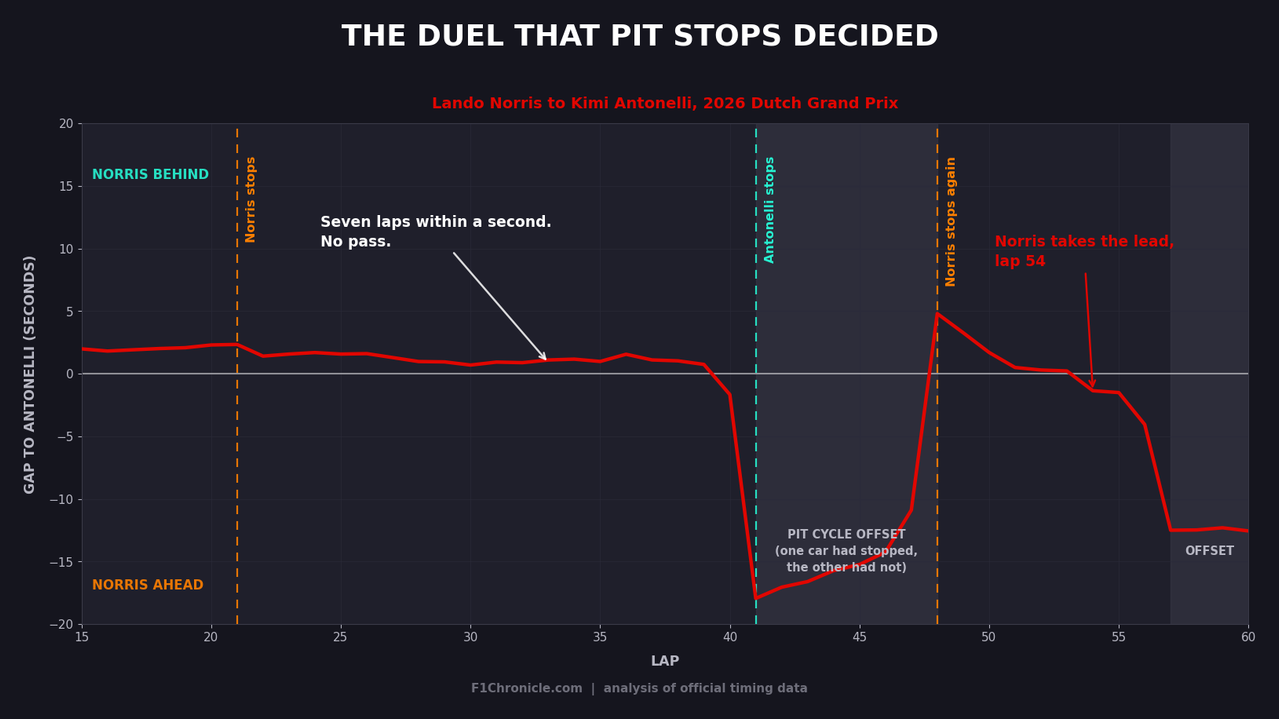
Norris rejoined 4.8 seconds behind Antonelli, but on tyres seven laps fresher, and the closing began at once. Over the first three laps back in traffic he closed at roughly 1.4 seconds a lap, a pace advantage on a completely different scale to anything seen earlier in the race: on equal rubber he had gained 0.66 seconds across an entire 17-lap stint, and now he was taking that much every half lap. The gap ran 3.27 seconds, then 1.70, then 0.50, then 0.30 and 0.22 across five consecutive laps, before Norris moved into the lead. Norris later credited the stop directly: “the team’s strategy was perfect, and that gave me the opportunity on fresh tyres to attack while Kimi was battling with Lewis.”
Why The Pass Still Took Three Laps
Even with a tyre advantage that had closed a near five-second deficit to under a quarter of a second, Norris did not simply drive past. He was within half a second of Antonelli for three consecutive laps, 0.50, then 0.30, then 0.22, before the move was completed, a reminder that a large pace advantage still has to be spent somewhere on a circuit with only one real passing zone. That zone is Turn 1, and that is exactly where the pass happened, on lap 53, immediately after Norris had already gone through Hamilton on the same lap. “Committing to the outside of Turn 1 was the move that won us the race,” Norris said afterwards, singling out the corner rather than the stop itself as the moment that decided it. Antonelli’s own account of the same sequence points to the same cause from the other side of it: “I didn’t have the feeling with the car on the second set of Hard tyres and that was when Lando was able to get past.”
Turn 1’s own layout is part of why the pass could happen there at all. Independent circuit analysis notes the corner’s wider camber gives an attacking driver more than one viable line through it, which is precisely what let Norris commit to the outside rather than needing a conventional inside move. That is a detail about the corner, not about the two cars, and it is consistent with a circuit where every other realistic passing opportunity had already closed itself off by the time the tyre advantage was there to use.
What The Tyres Were Doing
Across the top six finishers’ stints, the hard compound lost roughly 0.03 seconds a lap over a stint, against roughly 0.05 for the softs and mediums, the degradation gap that explains why the hard did so much of the compound allocation’s work at Zandvoort even with all three tyres available to every team. That gap is also why the hard was the tyre both Norris and Antonelli were on for the stint that decided the race, and why a seven-lap age difference on it was worth as much as it was. A tyre losing a little over a tenth of a second every three or four laps turns a modest age gap into a real pace gap far more reliably than a faster-degrading compound would.
What It Meant For The Championship
Norris’s win was his second in a row, and McLaren’s own account of the race calls it the team’s third consecutive victory at Zandvoort, following both drivers’ wins there in 2024 and 2025. The championship story ran the other way. Antonelli took second place and left the Netherlands on 242 points, a lead of 59 over George Russell and Lewis Hamilton, who tied on 183 apiece behind him, his advantage extending on a weekend where he did not take the chequered flag first. The margin between them at the flag traced back to a single pit wall decision and a single corner, not to a car that was comprehensively beaten across the afternoon, which is worth remembering given how little separated the two of them everywhere else on the lap. The pass that decided second and first on the road changed the story of the afternoon without changing the shape of the title fight, which is still being carried by the driver who did not win this particular pit lane battle.
Want more F1Chronicle.com coverage? Add us as a preferred source on Google to your favourites list for the best F1 news and analysis on the internet.
For more F1 news and videos, follow us on Microsoft Start.
New to Formula 1? Check out our Glossary of F1 Terms, and our Beginners Guide to Formula 1 to fast-track your F1 knowledge.
More F1 Reading
- Max Verstappen Says First Red Bull Engine Win Was Incredible After Hectic Bahrain Grand Prix Victory
- George Russell Admits His 2026 Title Hopes Are Now Exceptionally Unlikely After Cruel Bahrain GP Retirement
- Lewis Hamilton Reveals the Tyre Debate That Sank His Heart Before Remarkable Bahrain GP Recovery to Podium
- Max Verstappen Claims First Win Of 2026 At Chaotic Bahrain Grand Prix

Comments
More in News

Max Verstappen Says First Red Bull Engine Win Was Incredible After Hectic Bahrain Grand Prix Victory

George Russell Admits His 2026 Title Hopes Are Now Exceptionally Unlikely After Cruel Bahrain GP Retirement

Lewis Hamilton Reveals the Tyre Debate That Sank His Heart Before Remarkable Bahrain GP Recovery to Podium

Max Verstappen Claims First Win Of 2026 At Chaotic Bahrain Grand Prix
